
Small shaded gardens can bloom far better than most people expect. You do not need a big sunny border to get color for months. What you do need is the right kind of annual flower for the kind of shade you actually have—dappled shade under a tree, a bright east-facing bed, or a tight side yard that only gets a bit of morning sun.
- Quick Answer
- What Counts as Shade in a Small Garden?
- Best Shade Loving Annual Flowers for Small Gardens
- Wax Begonias
- Garden Impatiens
- New Guinea Impatiens
- Torenia
- Browallia
- Lobelia
- Pansies and Violas
- Sweet Alyssum
- How to Choose the Right Flower for Your Spot
- Planting Shade Annuals So They Actually Bloom
- Common Mistakes
- Treating All Shade as the Same
- Ignoring Dry Shade Under Trees
- Overcrowding Small Beds
- Using Cool-Season Flowers as Full-Summer Workhorses
- Practical Layout Ideas for Small Gardens
- For a Narrow Shady Border
- For a Porch Pot or Window Box
- For a Tree-Side Accent Bed
- FAQ
- What annual flowers bloom best in full shade?
- Can New Guinea impatiens grow in full shade?
- Which shade annual is best for containers?
- Do shade annuals need less water than sun annuals?
- What is the easiest shade flower for beginners?
- Can I grow sweet alyssum in shade?
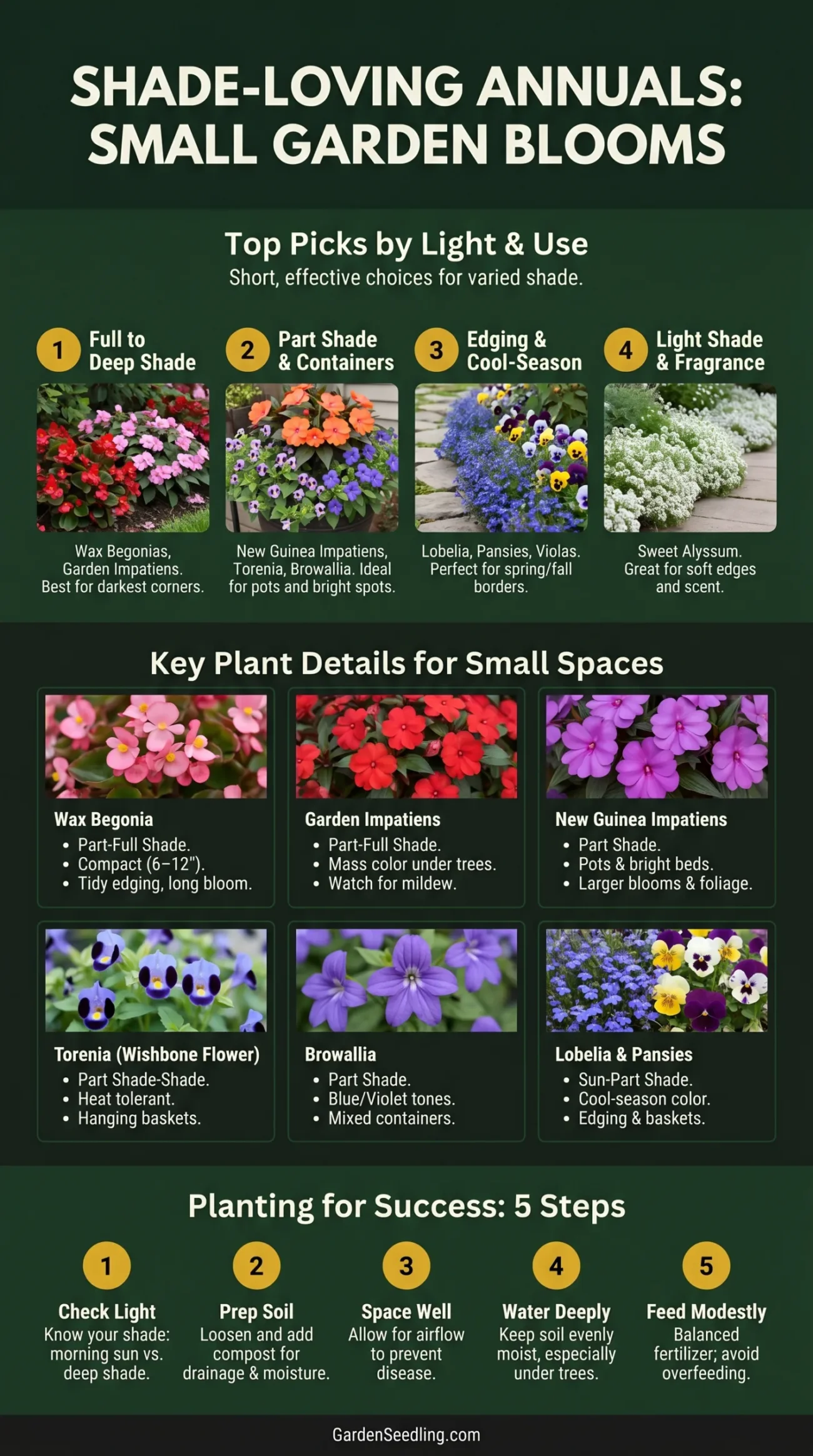
For most small spaces, the best shade loving annual flowers are wax begonias, garden impatiens, New Guinea impatiens, torenia, browallia, lobelia, pansies or violas, and sweet alyssum for lighter shade. Some bloom best in part shade, some handle deeper shade, and a few are better for spring or fall than the peak heat of summer. That part matters.
Quick Answer
If you want the shortest working list, start here:
- Best for full to fairly deep shade: wax begonias, garden impatiens
- Best for part shade and containers: New Guinea impatiens, torenia, browallia
- Best for edging and cool-season color: lobelia, pansies, violas
- Best for light shade and fragrance: sweet alyssum
For a small garden, compact plants with a mounding or trailing habit usually work best. They fill tight beds, tuck along paths, and do not turn into a messy thicket by midsummer.
| Flower | Best Light | Typical Size | Best Use in Small Gardens | What to Know |
|---|---|---|---|---|
| Wax Begonia | Part shade to full shade | 6–12 in. | Edging, window boxes, tight borders | Compact, neat, long bloom season |
| Garden Impatiens | Part shade to full shade | 6–24 in. | Mass color under shrubs or trees | Very floriferous, but watch for downy mildew issues |
| New Guinea Impatiens | Part shade | 6–20 in. | Pots, entry planters, bright shade beds | Larger flowers and foliage, better disease resistance |
| Torenia | Part shade to shade | 6–18 in. | Front edges, hanging baskets, narrow beds | Handles summer heat better than many people think |
| Browallia | Part shade | 12–24 in. | Mixed containers, small drifts | Great blue and violet tones, do not overfeed |
| Lobelia | Sun to part shade | 4–9 in. | Edging, baskets, cool-season filler | Best in cool weather; may fade in heat |
| Pansies and Violas | Sun to part shade | 4–9 in. | Spring beds, fall containers, path edges | Best outside peak summer heat |
| Sweet Alyssum | Light shade to part shade | 3–10 in. | Soft edging, spillers, walkway gaps | Fragrant; may pause in hot weather |
What Counts as Shade in a Small Garden?
Not all shade behaves the same. A bed that gets four hours of morning sun is very different from a bed under a maple tree that stays dim and dry most of the day.
Part shade usually means about 3 to 6 hours of direct sun, often gentler morning sun. Full shade means less than 3 hours of direct sun. Dappled shade sits in between, with light filtering through branches and leaves.
And then there is dry shade—the spot gardeners keep wrestling with. Under large trees, roots compete for moisture, and the canopy can block rainfall too. So even though the site looks cool, the soil may dry out fast. In those places, containers often work better than planting straight into the ground.
What if your garden gets only a few hours of morning sun? That is often enough for several shade annuals to flower well.
Best Shade Loving Annual Flowers for Small Gardens
Wax Begonias
Wax begonias are one of the safest picks for small shaded spaces. They stay compact, bloom for a long stretch, and keep a tidy mound instead of sprawling everywhere. In a narrow border or along a path, that clean shape helps a lot.

They work well in part shade, dappled shade, and even heavier shade, though bronze-leaved types usually take more sun than green-leaved ones. Flowers come in white, pink, and red, and the plants usually stay around 6 to 12 inches tall. For a tiny bed, that is just about right.
Use wax begonias where you want steady color without much fuss: mailbox beds, front walk edges, porch planters, or the shady side of a patio. They also mix nicely with ferns or leafy plants without getting swallowed up.
Garden Impatiens

For old-school shade color, garden impatiens still earn their place. Few annuals flower as freely in part shade to full shade, and few fill a bare shady patch so quickly. When the site is moist and not blasted by afternoon sun, they can bloom almost nonstop.
In small gardens, impatiens are useful because you can plant them in drifts and get a soft, full look without waiting all season. They fit under shrubs, at the front of a porch bed, or in a compact side-yard border where brighter sun lovers just give up.
One caution, though: common bedding impatiens can run into downy mildew in some areas. If that disease has shown up locally before, switch to mildew-resistant series or use New Guinea impatiens instead. Better to sidestep the problem than fight it all summer.
New Guinea Impatiens

New Guinea impatiens are a stronger fit for gardeners who want larger flowers, bolder leaves, and a bit more disease resistance. They do best in bright shade or part shade, and they suit containers especially well. In fact, they often look better in pots than in crowded beds.
They usually grow 6 to 20 inches tall, with a mounded habit that feels full but still controlled. In a small garden, that means fewer plants can cover the space. Nice bonus.
Use them in porch pots, window boxes, or near an entry where the blooms can actually be seen up close. They need steady moisture, more so if the site gets extra sun, so do not let containers dry to dust between waterings.
Torenia

Torenia, often called wishbone flower, deserves more attention than it gets. It is one of the better annual flowers for small shady gardens in summer, especially where lobelia or pansies fade once the heat settles in.
The plants stay low, often around 6 to 18 inches tall, and they bloom in purple, blue, pink, and white shades that look cool and clean in shade. The flowers have a slightly whimsical look—not flashy, just charming enough.
Torenia works best in rich, moist soil. It is a strong choice for the front of a bed, a hanging basket, or the edge of a container where stems can soften the rim. A light pinch early on can help it branch more and stay fuller.
Browallia

If you want blue or violet flowers in shade, browallia is one of the better answers. It handles part shade and warm weather well, and it has a soft rounded or slightly cascading habit that suits containers and tucked-in corners.
Most varieties grow about 1 to 2 feet tall and wide, so browallia needs a little more room than begonias or lobelia. Still, one plant can do the work of several smaller annuals, which makes it useful in a compact bed where every square foot has to count.
There is one easy mistake here: too much fertilizer. Browallia can push extra foliage and fewer flowers when fed too heavily. Keep the soil fertile, yes, but do not pour on high-nitrogen products every week.
Lobelia

Lobelia is one of the prettiest edging plants for small gardens. The flowers—usually blue, violet, purple, pink, or white—cover the plant so heavily in cool weather that the foliage nearly disappears. For spring beds and small baskets, it is hard to beat.
It stays small, usually 4 to 9 inches tall, and works beautifully along paths, at the lip of containers, or as a soft filler around taller annuals. Trailing forms are especially useful in hanging baskets.
Here is the catch: lobelia likes cooler conditions. In hot, humid summer weather it often slows down, gets tired-looking, or needs a cutback to recover. That does not make it a bad plant. It just means it is often best as a spring-to-early-summer performer, or as a fall planting in milder regions.
Pansies and Violas

Pansies and violas are not classic summer shade plants in hot climates, but they are excellent for cool-season color in part shade. In small gardens, they punch above their weight because the flowers are showy, the plants stay low, and they fit almost anywhere.
Use them in spring beds, fall containers, and around stepping stones or porch edges. They usually stay under 12 inches tall and wide, so they do not bully nearby plants.
They are best where summers are mild or where the planting is meant for spring and fall display. Once the heat ramps up, many pansies decline fast. Violas usually hold on a bit longer.
Sweet Alyssum

Sweet alyssum is not the best plant for heavy shade, but for light shade or part shade it earns a spot on the list—especially in a small garden where fragrance and soft edges matter. The flowers are tiny, but they appear in dense clusters, and the plants spread into low mounds.
It usually grows about 3 to 10 inches tall and 6 to 12 inches wide. That makes it useful between stepping stones, along walkway edges, or spilling over the sides of containers.
In cool weather it blooms heavily. In hot weather it may pause, look a bit rough, then rebound after a light trim and better conditions. So, yes, a little uneven at times. Still useful.
How to Choose the Right Flower for Your Spot
If the bed gets bright morning sun and afternoon shade, choose New Guinea impatiens, torenia, browallia, wax begonias, or sweet alyssum.
If the bed sits in deeper shade, lean toward wax begonias and garden impatiens first. They are more reliable there than pansies, alyssum, or lobelia.
If the site is under a tree with thirsty roots, plant in containers or improve the soil with compost and be ready to water more often. Shade does not always mean moist soil. That trips people up, over and over.
If you want the neatest look in the least space, pick plants with a mounded habit. For a softer, spilling edge, use trailing lobelia or alyssum. For more vertical presence, use browallia or taller New Guinea impatiens.
Planting Shade Annuals So They Actually Bloom
- Check the light first. Spend a day watching the bed. Morning sun, dappled shade, and deep afternoon shade are not the same thing.
- Loosen the soil and add compost. Shade annuals usually do best in loose, moisture-holding, well-drained soil.
- Space plants for air flow. Small gardens get crowded fast. Leave enough room so leaves dry after watering and plants do not mash together.
- Water deeply after planting. Then keep the soil evenly moist while roots settle in.
- Mulch lightly. A thin mulch layer helps keep moisture steady and cuts soil splash on leaves.
- Feed modestly. Use a balanced fertilizer, but do not overdo it. Too much feed often means more leaves, fewer flowers.
- Tidy as needed. Trim back tired lobelia or alyssum, pinch torenia lightly, and remove rough growth when plants start to stall.
Common Mistakes
Treating All Shade as the Same
Deep shade is not part shade. Many “shade” flowers still need some usable light to bloom well. If the bed is truly dark, focus on the strongest bloomers for low light, or use containers that can be shifted into brighter spots.
Ignoring Dry Shade Under Trees
A shaded bed under a mature tree may look cool and moist, but tree roots often pull moisture fast. Flowers wilt, gardeners water more, then wonder why the bed still struggles. Root competition is usually the missing piece.
Overcrowding Small Beds
Small spaces make people want to plant every gap. Resist that urge a bit. Crowding cuts air flow, raises disease pressure, and makes each plant look worse, not better.
Using Cool-Season Flowers as Full-Summer Workhorses
Lobelia, pansies, violas, and sometimes alyssum may not carry the whole summer in hot regions. Plan for a seasonal swap if needed.
Practical Layout Ideas for Small Gardens
For a Narrow Shady Border
Use wax begonias in the front and browallia or New Guinea impatiens behind them. The height stays manageable, and the bed does not feel cluttered.
For a Porch Pot or Window Box
Use New Guinea impatiens as the center plant, torenia around it, and a little alyssum or trailing lobelia near the edge if the box gets enough light. That mix reads full without feeling bulky.
For a Tree-Side Accent Bed
Keep it simple: a drift of garden impatiens or wax begonias in improved soil, or put those same flowers in containers tucked under the canopy. Sometimes the container route is just easier. Honestly, it often looks better too.
FAQ
What annual flowers bloom best in full shade?
Wax begonias and garden impatiens are usually the most reliable bloomers in fuller shade. Torenia can also do well if the site is not too dark.
Can New Guinea impatiens grow in full shade?
They can survive in deeper shade, but they usually bloom better in bright shade or part shade. Too little light can reduce flowering.
Which shade annual is best for containers?
New Guinea impatiens, torenia, and wax begonias are all strong container choices. Pick based on the amount of light and the size of the pot.
Do shade annuals need less water than sun annuals?
Sometimes, but not always. Under trees or in pots, shade annuals can dry out quickly and may need regular watering.
What is the easiest shade flower for beginners?
Wax begonias are one of the easiest. They stay compact, bloom for a long season, and handle a range of light levels well.
Can I grow sweet alyssum in shade?
Yes, but it does best in light shade or part shade, not deep shade. Too little light usually means fewer flowers.
Small gardens do not need many plants to look full. They just need the right ones, placed where the light and soil actually match. Start with two or three dependable shade annuals, keep the layout simple, and let the blooms do the work.