
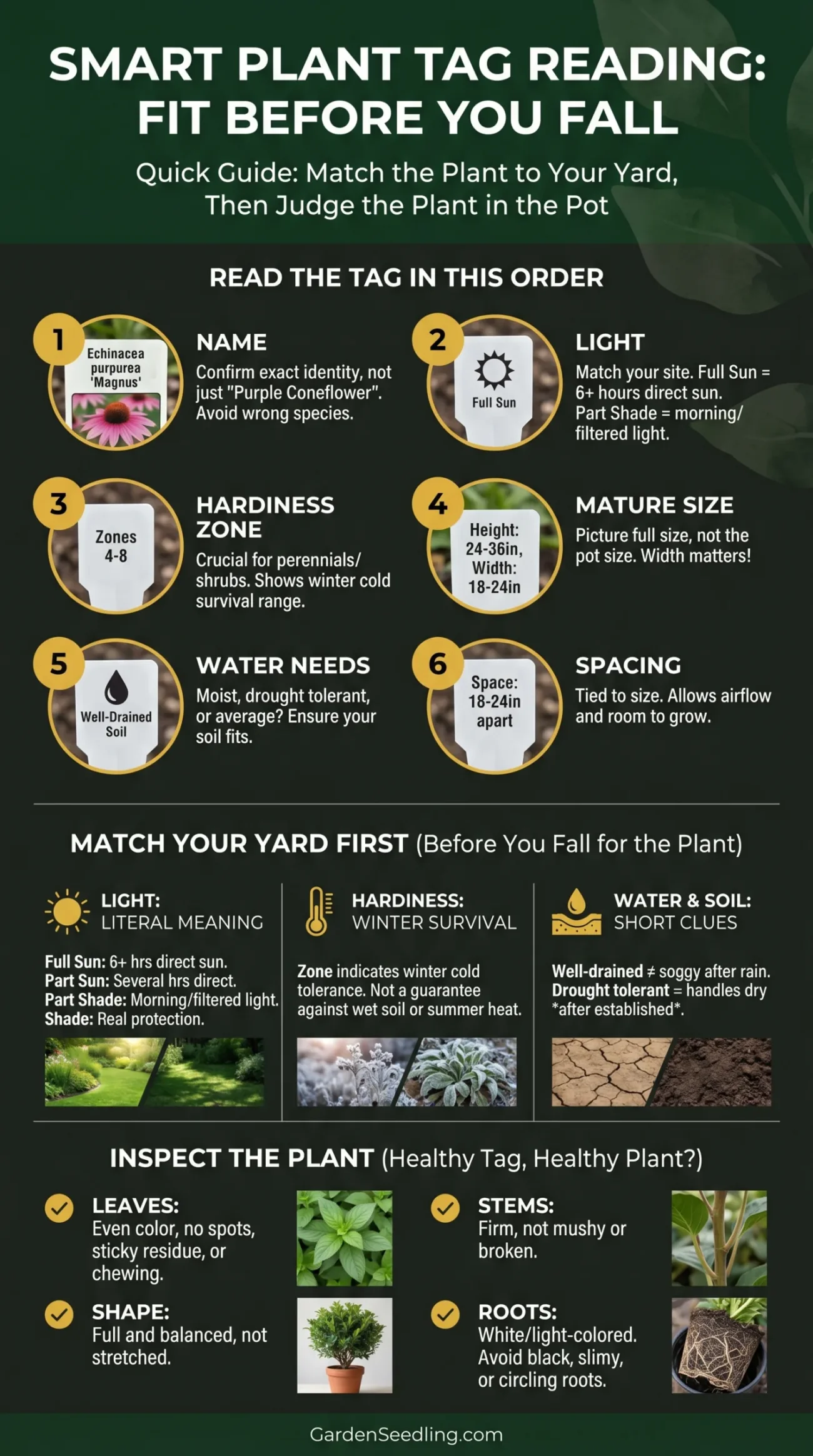
A glossy bloom photo can pull you in fast, but the small plastic tag does the real work. If you want to know whether a plant will live past next month, fit the space, and handle your yard, you need to read that tag before you buy. That is really what how to read plant tags at garden centers before you buy comes down to: match the plant to your yard first, then judge the plant sitting in the pot.

- What A Plant Tag Usually Tells You
- Start With The Name, Not The Picture
- Match The Tag To Your Yard Before You Fall For The Plant
- Light: Read It Literally
- Hardiness Zone: Mostly About Winter Survival
- Water And Soil Notes: Short Words, Big Clues
- Read The Size Line Like It Actually Matters
- How To Read Plant Tags In A Fast, Practical Order
- Do Not Stop At The Tag—Inspect The Plant In Front Of You
- What A Healthy Plant Usually Looks Like
- Terms On Plant Tags That Often Trip People Up
- Annual, Perennial, Biennial
- Native
- Pollinator Friendly
- Deer Resistant
- PP, PPAF, Or Patent Notes
- Common Buying Mistakes Plant Tags Could Have Prevented
- A Smart Way To Compare Two Similar Plants
- FAQ
- Do Plant Tags Tell The Truth About Mature Size?
- What Does Full Sun Mean On A Plant Tag?
- Should I Buy A Plant Just Because It Is Blooming At The Store?
- Does Perennial Mean The Plant Will Always Come Back?
- What Does PPAF Mean On A Plant Tag?
Quick Answer: Read the tag in this order: name, light, hardiness zone, mature size, water needs, and spacing. Then look at the actual plant. Choose a plant whose tag matches your site and whose roots, leaves, and stems look healthy. If the tag and your yard do not line up, leave it there.
It sounds simple. Still, plenty of gardeners buy by flower color, bring the plant home, and only later notice that it wants six hours of sun, dry soil, and four feet of width. By then, the spot is wrong and the plant is already on borrowed time.
What A Plant Tag Usually Tells You
Most garden center tags give you enough information to make a solid buying call in under half a minute. Not every tag includes every detail, but these are the lines worth hunting for.
| Tag Item | What It Means | Why It Matters Before You Buy |
|---|---|---|
| Common Name | The everyday name, like coneflower or boxwood | Useful, but not precise enough by itself |
| Botanical Name | The exact plant identity, such as Echinacea purpurea | Helps you avoid buying the wrong species or variety |
| Cultivar Name | A selected variety, often in single quotes | Tells you which version you are getting |
| Light | Full sun, part sun, part shade, shade | Wrong light is one of the fastest ways to fail |
| Hardiness Zone | The winter cold range the plant can handle | Especially useful for perennials, shrubs, and trees |
| Mature Height And Width | Expected size after the plant settles in and grows up | Stops crowding, pruning headaches, and bad spacing |
| Water Or Soil Notes | Moist, well-drained, drought tolerant, average soil | Shows whether your site is a fit |
| Spacing | How far apart to plant | Helps with airflow and room to grow |
| Bloom Time Or Harvest Window | When flowers or crops usually show up | Helps you plan color and harvest timing |
Start With The Name, Not The Picture
The photo on the tag shows the plant at its best, often at full bloom or peak color. Useful? Sure. But it is not the first line to trust. Start with the name, because that tells you what plant you are actually buying.
The common name is helpful, though it can be loose. “Daisy” covers a lot of ground. The botanical name is tighter and far more reliable. If two plants look similar on the bench but carry different botanical names, treat them as different plants with different habits. Sometimes very different.
Then look for the cultivar name. That is the named selection, often shown like this: Hydrangea paniculata ‘Limelight’. The cultivar matters because one hydrangea may stay compact while another turns into a much larger shrub. Same plant family. Different outcome.
You may also see a trade name, trademark symbol, or a patent note such as PP or PPAF. For the shopper, this mostly tells you the plant is a named selection in the nursery trade. It does not mean it is better for your garden. It only means you should pay closer attention to the actual growth and care notes on the tag.
Match The Tag To Your Yard Before You Fall For The Plant
This is where smart buying starts. Garden centers sell plants from sunny patio annuals to shade shrubs to moisture-loving perennials, all in one place. The store can stock them together. Your yard cannot.
Light: Read It Literally
If the tag says full sun, think six or more hours of direct sun in the growing season. If it says part sun, the plant usually handles several hours of direct sun but not all-day blasting heat. Part shade leans gentler and often means morning sun or filtered light works better. Shade plants want protection, and not the weak sort of “maybe this corner gets enough” protection. Real relief from strong afternoon sun.
Some tags list two terms, like sun/part sun or part shade/shade. Read the first term as the plant’s better fit and the second as what it can tolerate. Small detail, big difference.
If you do not know your light, do not guess. Check the planting area on a bright day—morning, noon, and late afternoon. That quick walk tells you more than the sales bench ever will.
Hardiness Zone: Mostly About Winter Survival
For annuals, the zone line may not matter much because they are meant to finish in one season. For perennials, shrubs, and trees, it matters a lot. A hardiness zone tells you the winter cold a plant can usually survive. It is not a promise, though. A plant can be zone-hardy and still struggle if the soil stays wet, the site gets winter wind, or summer heat piles on harder than the plant likes.
So if your yard sits in Zone 6 and the tag says Zones 7 to 9, that plant is a risk outdoors year-round. Maybe it works in a pot that you protect. Maybe it acts like an annual. But do not buy it as a dependable perennial border plant and hope for the best.
Water And Soil Notes: Short Words, Big Clues
Garden tags often use quick terms like well-drained, moist soil, drought tolerant, or average garden soil. Those little phrases matter more than the color photo, honestly. A lavender tag that asks for sharp drainage should not go into a bed that stays soggy after rain. A cardinal flower that likes moisture will not be happy baking in dry gravel.
When a tag says “drought tolerant,” read that with a little caution. It usually means the plant handles dry periods after it establishes, not that a fresh transplant can skip watering right away.
Read The Size Line Like It Actually Matters
Many shoppers read height and ignore width. That is backwards for a lot of plants. On a shrub tag, width often matters more than height.
Mature size tells you where the plant belongs, how many you need, and whether future pruning will become a regular chore. A compact perennial that reaches 12 to 18 inches wide can tuck into the front of a bed. A shrub that spreads 5 feet needs breathing room from the start. Plant it 18 inches from the walkway because it looked “small enough” in a 2-gallon pot, and you will be fighting it every season.
Spacing is tied to size, too. Good spacing improves airflow, lowers disease pressure, and keeps the bed from turning into a jammed, tangled mass by midsummer. New gardeners often space for today’s pot size. Experienced gardeners space for next year—and the year after that.
How To Read Plant Tags In A Fast, Practical Order
When you are standing in front of a bench full of plants, use this short routine.
- Read the name. Confirm the exact plant, not just the flower color.
- Check the light line. Make sure your spot truly matches it.
- Check the zone. This matters most for anything you expect to keep for years.
- Read mature height and width. Picture the plant at full size, not in the pot.
- Look for water and soil notes. Wet site, dry site, average bed—match them honestly.
- Then inspect the plant itself. Healthy tag, weak plant? Put it back.
That order works. It keeps you from buying a plant for the wrong reason.
Do Not Stop At The Tag—Inspect The Plant In Front Of You
A tag can be right and the plant can still be a poor buy. So, before you commit, look at the plant itself.
What A Healthy Plant Usually Looks Like
- Leaves: Even color for the variety, no major spotting, no sticky residue, no heavy chewing
- Stems: Firm, not mushy or badly broken
- Shape: Full and balanced, not stretched and floppy
- Flowers: A few open blooms are fine, but heavy bloom can sometimes mean the plant is farther along than you want
- Roots: White or light-colored, not black, slimy, or sour-smelling
If the plant slides out of the pot easily, check the root ball. A few roots around the edge are normal. A dense knot of circling roots is not. On fast-growing annuals it may be manageable. On shrubs and trees, badly circling roots can become a long-term problem.
Also look at the soil surface. Moss, weeds, or crusted salt buildup can hint that the plant sat there too long. One small weed is not a disaster. A pot that looks tired all over usually is.
Terms On Plant Tags That Often Trip People Up
Annual, Perennial, Biennial

Annuals finish their life cycle in one growing season. Perennials can return for more than one year if the climate and site suit them. Biennials usually grow leaves the first year and flower the second. If you want something to come back, do not assume. Check the tag.
Native

A native label can be useful, but it is not a free pass. Native plants still need the right light, moisture, spacing, and soil. Some are easy. Some are fussy. Read the rest of the tag, always.
Pollinator Friendly

This can point you in a helpful direction, but it is still a broad label. If pollinator support is your goal, favor plants with simple, open flowers over heavily doubled forms, and think in seasons—spring, summer, and fall bloom—not just a single pretty week in June.
Deer Resistant

“Deer resistant” does not mean “deer proof.” It means deer tend to leave it alone more often than other plants. In a hungry season, deer can sample almost anything.
PP, PPAF, Or Patent Notes

These notes tell you the plant is patented or has a patent application tied to it. For the average gardener, the main reading point is simple: this is a named nursery selection, so pay close attention to the tag’s real growth details rather than assuming the brand name tells you enough.
Common Buying Mistakes Plant Tags Could Have Prevented
- Buying for bloom color only and missing the light requirement
- Ignoring width and planting too close to paths, siding, or other plants
- Treating zone as optional for a plant meant to live outdoors year-round
- Reading “drought tolerant” as “never water”
- Taking “part shade” too loosely and putting the plant in deep gloom
- Skipping root inspection because the top growth looks pretty
- Buying a stressed clearance plant without noticing leaf spots, wilt, or pests
And one more: buying too early. A warm afternoon at the garden center can make tender plants look ready, even when outdoor nights are still cold enough to set them back hard. The tag may not spell that out. You still need to think seasonally.
A Smart Way To Compare Two Similar Plants
Say you are choosing between two salvias, two hydrangeas, or two tomatoes that look good on the bench. Use the tag to compare the parts that will matter later.
| Compare This | Plant A | Plant B | Better Choice If You Need… |
|---|---|---|---|
| Light Need | Full Sun | Part Sun | The one that matches your actual site |
| Mature Width | 18 inches | 36 inches | The size your bed can handle without crowding |
| Hardiness | Zone 5 | Zone 7 | The one that can stay outside in your climate |
| Water Need | Average | Moist | The one that fits your irrigation and soil |
That kind of comparison keeps emotion from making the whole decision. Helpful, honestly.
FAQ
Do Plant Tags Tell The Truth About Mature Size?
Usually they give a fair range, but real size still depends on climate, soil, water, pruning, and time. Treat the size line as a planning tool, not a fixed promise.
What Does Full Sun Mean On A Plant Tag?
It usually means the plant wants at least six hours of direct sun during the growing season. More than that can be fine if the plant and climate fit.
Should I Buy A Plant Just Because It Is Blooming At The Store?
No. Bloom is nice, but root health, leaf condition, and a tag that matches your site matter more.
Does Perennial Mean The Plant Will Always Come Back?
No. It only comes back reliably when your climate and growing conditions suit it.
What Does PPAF Mean On A Plant Tag?
It means Plant Patent Applied For. It is a nursery trade and legal note, not a shortcut for whether the plant fits your yard.
Once you get used to reading tags this way, garden center shopping gets calmer. Faster, too. You stop buying plants that only look good on the bench and start choosing plants that have a real shot at thriving once they leave the pot.