
Some perennial beds get crowded long before gardeners notice it. Blooms get smaller, the middle starts to thin out, and a plant that used to look full suddenly looks tired by midsummer. That is often the moment to divide perennials—not just to tidy the bed, but to make stronger plants and get free new ones at the same time.
- Quick Answer
- Why Division Helps
- When To Divide Perennials
- What You Need Before You Start
- How To Divide Perennials Step By Step
- 1. Cut Back Excess Top Growth
- 2. Dig Wide, Not Tight
- 3. Shake Off Loose Soil
- 4. Split The Clump
- 5. Trim Out Weak Or Dead Parts
- 6. Replant Right Away
- 7. Water Deeply
- How To Handle Different Root Types
- Perennials That Usually Divide Well
- Perennials To Leave Alone Or Divide Rarely
- Practical Tips For Faster Recovery
- Common Mistakes To Avoid
- FAQ
- How Often Should You Divide Perennials?
- Can You Divide Perennials In Summer?
- Should You Water Before Dividing Perennials?
- What Is The Best Perennial For Beginners To Divide?
- Can You Divide A Plant And Put Part Of It Back In The Same Spot?
Why buy more plants when one healthy clump can turn into three or four? If you divide perennials at the right time, keep the roots from drying out, and replant fast, you can multiply your garden without making the bed look chopped up or stressed. Done well, it feels less like surgery and more like resetting the plant so it can grow the way it wanted to all along.
Quick Answer
To divide perennials, dig the clump while it is not in bloom, lift it with as much root as possible, split it into smaller sections with healthy roots and several shoots or buds, then replant each piece at the same depth in prepared soil and water well. Early spring works for many summer- and fall-blooming perennials. Many spring bloomers do better after flowering or from late summer into early fall, as long as they still have time to root in before hard freeze.
Why Division Helps
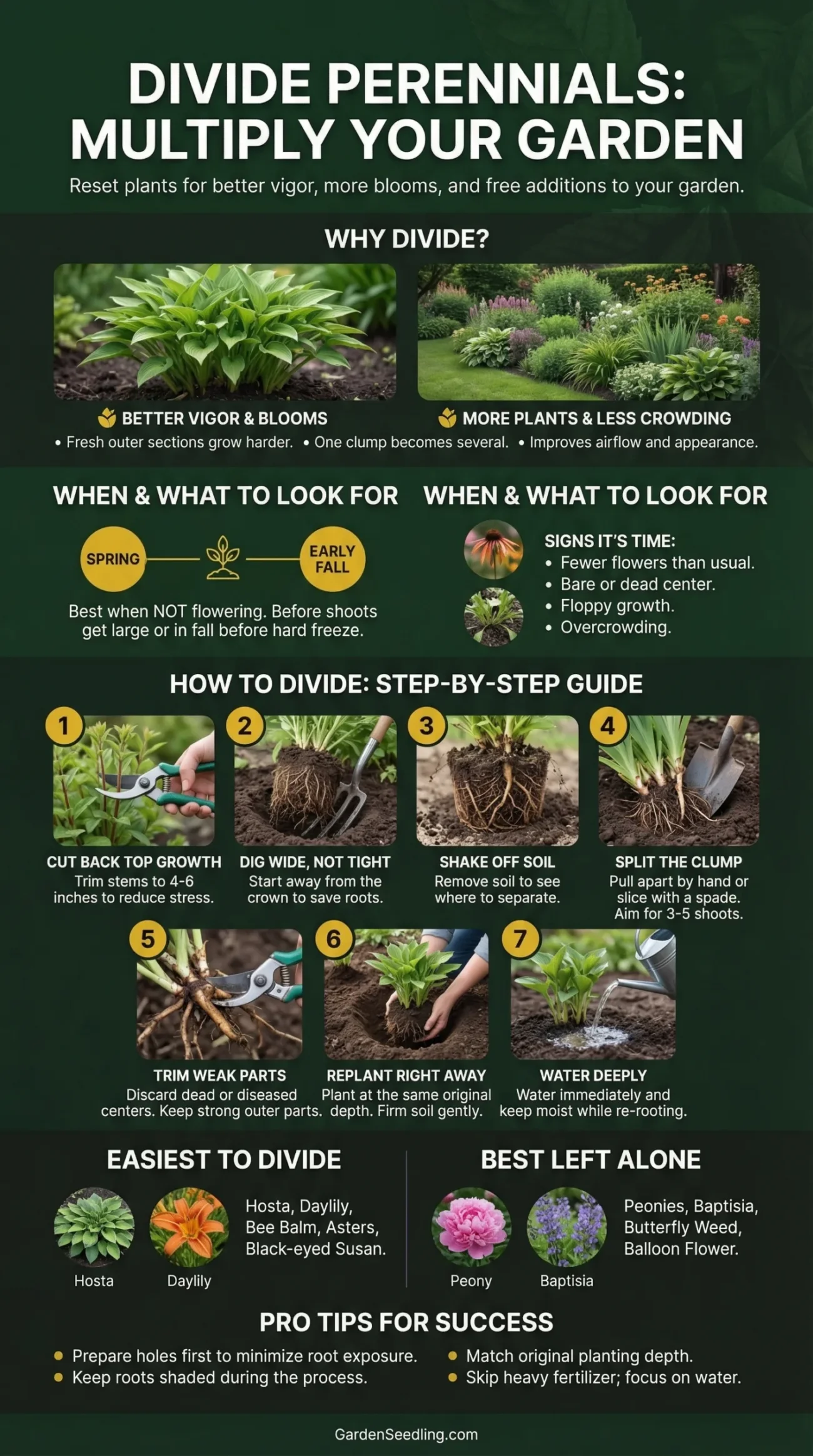
Division does three useful things at once. It gives crowded roots more room, it refreshes older clumps, and it gives you extra plants for new beds, borders, or pots. In many cases, flowering improves after division because the plant is no longer spending all its energy competing with its own old crown.
It also helps with garden layout. A hosta that has turned into a giant mound, a daylily that keeps creeping wider, or a bee balm patch that is getting floppy can all be split and reset where you actually want them. Simple, really.
- Better vigor: Fresh outer sections usually grow harder and bloom better than tired centers.
- More plants: One clump can become several plantable pieces.
- Less crowding: Airflow improves, and the bed looks cleaner.
- Size control: Fast spreaders stay where they belong.
When To Divide Perennials
The easiest rule is this: divide when the plant is not flowering. That shifts energy toward root recovery instead of blooms. After that, timing depends on the kind of perennial and how it grows.
For many gardens in the U.S., spring and early fall are the main windows. Spring is often easiest because shoots are small and the whole root system is easier to see. Fall also works well, but only if the plant has enough time to settle before the ground freezes hard.
| Perennial Group | Best Time To Divide | Common Examples | What To Watch |
|---|---|---|---|
| Summer- and Fall-Blooming Perennials | Early spring | Asters, bee balm, black-eyed Susan, ornamental grasses, garden phlox | Divide as new growth starts, before stems stretch |
| Spring-Blooming Perennials | After bloom or late summer to early fall | Bleeding heart, coral bells, some hardy geraniums | Let flowering finish first |
| Rhizome-Forming Plants | Usually after flowering, often late summer | Bearded iris | Do not bury rhizomes too deep |
| Large Clump Formers | Spring or early fall | Hosta, daylily | Lift the full clump if possible, then split |
Good signs a perennial needs dividing:
- Fewer flowers than usual
- Bare or dead center in the clump
- Floppy growth that used to stand up better
- Overcrowding or spread beyond its space
- Smaller leaves or weaker stems even with decent care
One small note: do not divide on a hot, dry, windy afternoon if you can help it. A cool, cloudy day is better. If rain is coming, even better.
What You Need Before You Start
You do not need fancy gear, but clean tools help. A dull shovel makes a bigger mess of roots than people expect.
- Spade or digging fork
- Sharp soil knife, hori hori, or pruning saw for dense crowns
- Hand pruners to trim top growth if needed
- Tarp or wheelbarrow to hold the lifted clump
- Compost for replanting holes or bed refresh
- Hose or watering can
- Labels if you are splitting named varieties
Water the plant a day before dividing if the soil is dry. That one step makes digging easier and lowers stress on the plant. Also prepare the new holes first—roots should not sit in the sun while you decide where everything goes.
How To Divide Perennials Step By Step
1. Cut Back Excess Top Growth

If the clump is tall or floppy, trim stems back to roughly 4 to 6 inches. You do not always have to do this, but it makes large plants easier to handle and slows water loss while the roots recover.
2. Dig Wide, Not Tight

Start several inches away from the crown so you keep more roots intact. Work around the clump in a circle with a spade or fork, then lever it up. For really old hostas or ornamental grasses, this takes some effort. Sometimes a lot.
3. Shake Off Loose Soil

Brush or shake away enough soil to see where the crown separates naturally. You are looking for buds, shoots, fans, or sections with their own root mass. Old woody centers can often be discarded.
4. Split The Clump

Use the method that fits the root type:
- Loose, fibrous clumps: Pull apart by hand.
- Dense crowns: Slice with a clean spade or knife.
- Big root masses: Two garden forks back-to-back can pry sections apart.
- Rhizomes: Cut clean pieces with healthy leaf fans and good roots attached.
Aim for divisions with 3 to 5 healthy shoots or buds and a solid root system. Tiny pieces can survive, sure, but larger divisions usually settle in faster and look better sooner.
5. Trim Out Weak Or Dead Parts

Do not replant mushy, hollow, badly damaged, or obviously diseased sections. Keep the strongest outer growth. That outer ring is often the best part of an old clump anyway.
6. Replant Right Away

Set each division into its new hole at the same soil level it had before. Spread roots outward instead of stuffing them into a narrow hole. Firm the soil gently around the crown so there are no large air pockets.
7. Water Deeply

Water right after planting. Then keep the soil evenly moist while the plant re-roots. Not soggy. Just steady. A light mulch helps hold moisture and keeps weeds from taking advantage of disturbed soil.
How To Handle Different Root Types
Not all perennials divide the same way, and this is where many gardeners hesitate. Fair enough.
- Hostas: Lift the whole clump and cut between visible crowns. Each section should have roots and several eyes or shoots.
- Daylilies: Split into fans with roots attached. Keep the younger outside sections; old centers can be tossed if they are weak.
- Bee Balm, Asters, Yarrow: These often pull or cut into easy clumps. Fast growers, generally forgiving.
- Bearded Iris: Divide after bloom, usually later in summer. Replant healthy rhizomes shallowly, with the top near or just above the soil surface.
- Ornamental Grasses: Divide in spring when growth starts. Dense crowns may need a saw, a sharp spade, or a bit of stubbornness.
Perennials That Usually Divide Well
These are often good picks if you want to multiply plants without much drama:
- Hosta
- Daylily
- Bee balm
- Asters
- Black-eyed Susan
- Yarrow
- Garden phlox
- Coreopsis
- Sedum (many clumping kinds)
- Ornamental grasses (many types, especially when crowded)
If you are new to dividing, start with hosta or daylily. They are forgiving, easy to read, and the reward is obvious fast.
Perennials To Leave Alone Or Divide Rarely
This part matters. Not every perennial wants to be split. Some can sit for many years with no problem, and some really dislike being disturbed.
- Peonies: Often do best when left alone for a long time.
- Baptisia (false indigo): Deep-rooted and not eager to be moved.
- Butterfly weed: Long taproot, usually better left in place.
- Balloon flower: Can resent root disturbance.
- Baby’s breath and flax: Often not top choices for routine division.
If a plant forms a deep taproot or simply performs well for years without crowding, skip division unless you have a real reason to move it. Let the plant be the signal, not just the calendar.
Practical Tips For Faster Recovery
- Prepare holes first so roots are out of the ground for the shortest time possible.
- Mix in compost if the soil is tired, compacted, or low in organic matter.
- Keep roots shaded if you are working in warm weather.
- Match the original depth unless that plant has a special need, like shallow-planted iris rhizomes.
- Water again after a couple of days if weather is dry, windy, or oddly hot.
- Skip heavy fertilizer right away. Fresh divisions need root recovery first, not a hard push of top growth.
Common Mistakes To Avoid
Most failures come from timing and aftercare, not from the actual cutting.
- Dividing during full bloom: The plant is already spending energy on flowers.
- Making divisions too small: Tiny pieces stall more easily.
- Letting roots dry out: A few hot minutes in sun can set plants back.
- Planting too deep: Crowns and rhizomes can rot or sulk.
- Forgetting to water: Newly divided plants need steady moisture while they re-establish.
- Dividing everything on the same schedule: Some perennials want it, some really do not.
And one more: do not feel forced to divide a healthy clump just because it has been three years. If it still flowers well, holds shape, and fills its space nicely, you can wait.
FAQ
How Often Should You Divide Perennials?
Many clump-forming perennials benefit from division every 3 to 5 years, but timing varies by plant. Use plant signals like fewer blooms, a bare center, or overcrowding instead of following one fixed schedule.
Can You Divide Perennials In Summer?
Yes, some can be divided in summer, especially after flowering. Bearded iris is a common example. Avoid extreme heat, keep roots moist, and water well after replanting.
Should You Water Before Dividing Perennials?
Yes. Watering the day before makes digging easier and helps the plant handle the move with less stress, especially in dry soil.
What Is The Best Perennial For Beginners To Divide?
Hosta and daylily are two of the easiest. Both are forgiving, easy to split, and usually recover well when replanted quickly.
Can You Divide A Plant And Put Part Of It Back In The Same Spot?
Yes. That is a common way to refresh an overgrown clump. Remove the tired center, improve the soil a bit, then replant healthy outer sections with better spacing.
Once you get the timing right, dividing perennials stops feeling like a risky garden job. It becomes one of those useful, almost satisfying chores—part cleanup, part propagation, and a very good way to make one plant do more.