
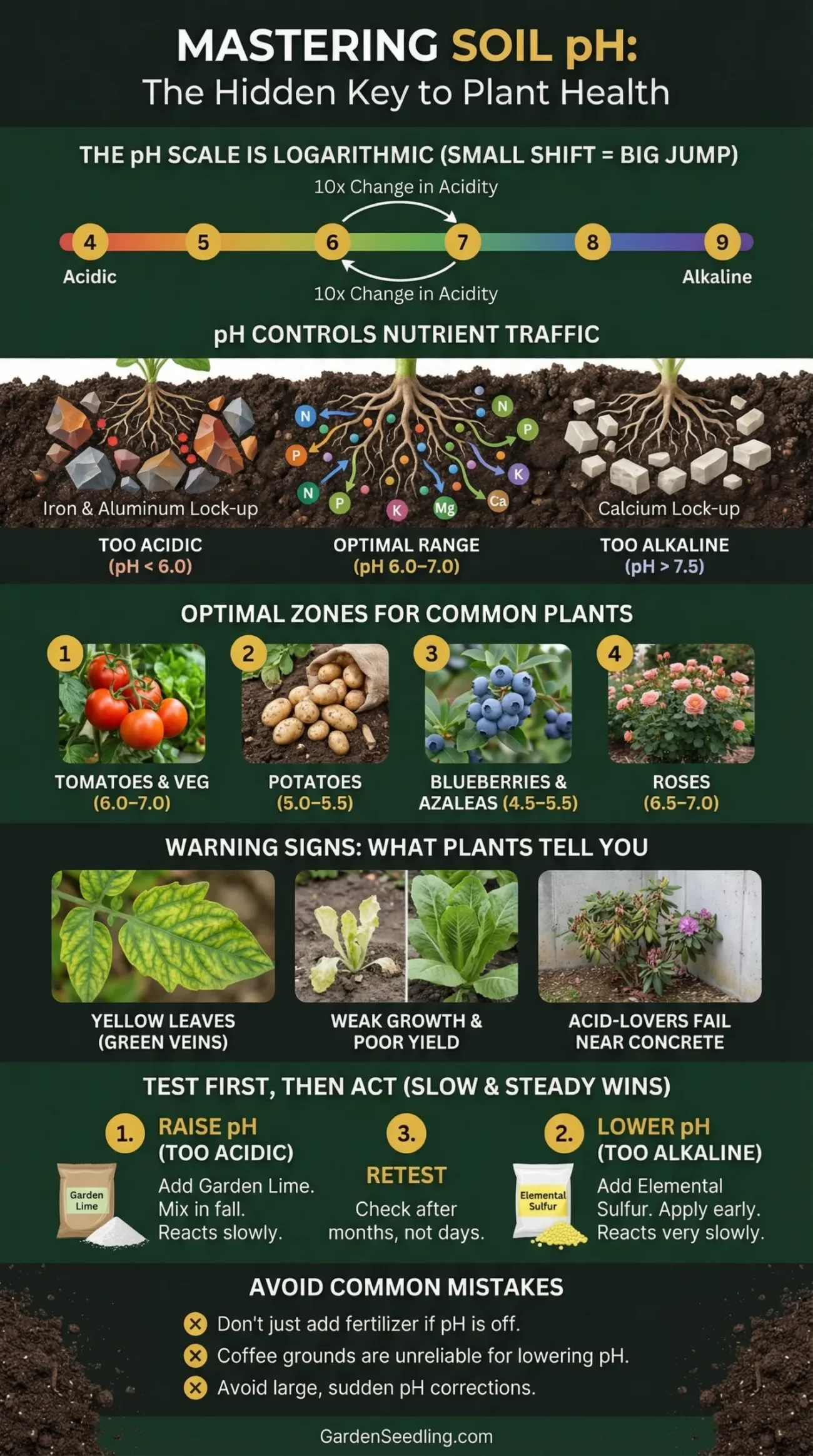
A garden bed can test “fertile” and still grow pale, stunted plants. That throws people off. The missing piece is often soil pH—not because pH feeds plants by itself, but because it decides how easy it is for roots to reach the nutrients already sitting in the soil.
- What Soil pH Really Tells You
- Why Soil pH Matters More Than Many Gardeners Expect
- Nutrient Availability Changes With pH
- Micronutrients Can Swing Fast
- Roots, Microbes, and Soil Life Respond Too
- Best Soil pH Range for Common Garden Plants
- How to Tell When Soil pH May Be Off
- How to Test Soil pH the Right Way
- Step-By-Step
- How to Raise Low Soil pH
- What Helps
- How to Lower High Soil pH
- What Helps
- Blueberries Need Their Own Strategy
- Raised Beds, Containers, and Compost: A Few Practical Notes
- Common Mistakes Gardeners Make With Soil pH
- Using Fertilizer Instead of Fixing pH
- Trying to Acidify Soil With Coffee Grounds
- Using Wood Ash Without Testing
- Overcorrecting
- Ignoring Plant-Specific Needs
- How to Use Soil pH as a Real Garden Tool
- FAQ
- What Is The Best Soil pH For Most Garden Plants?
- How Often Should You Test Soil pH?
- Can You Change Soil pH Quickly?
- Do Coffee Grounds Lower Soil pH?
- Is Soil pH More Important Than Fertilizer?
If you grow vegetables, flowers, herbs, or berry plants, understanding soil pH helps you make better choices before you add lime, sulfur, compost, or fertilizer. And honestly, it can save a lot of wasted effort.
Quick Answer: Soil pH matters because it changes how available nutrients are to plant roots. Most garden plants do best in soil that is slightly acidic to neutral, usually around pH 6.0 to 7.0. If the pH is too low or too high, plants may struggle even when the soil contains enough nutrients. A simple soil test tells you where you stand and whether you need lime to raise pH or elemental sulfur to lower it.
What Soil pH Really Tells You
Soil pH measures how acidic or alkaline your soil is. A pH of 7 is neutral. Numbers below 7 are acidic. Numbers above 7 are alkaline.
That part is simple. The part many gardeners miss is this: pH is not a small shift. It works on a logarithmic scale, so one full pH point is a big jump, not a tiny nudge. A soil at pH 6 is much more acidic than a soil at pH 7.
That is why small-looking changes on a soil report can affect plant growth in a very real way.
Why Soil pH Matters More Than Many Gardeners Expect
Plants do not eat fertilizer straight from the bag. Roots take in nutrients only when those nutrients are in a form the plant can use. Soil pH controls a lot of that traffic.
Nutrient Availability Changes With pH

In soil that is too acidic, some nutrients become less available, while others can become too available. In soil that is too alkaline, a different set of nutrients gets tied up. Either way, plants can end up looking hungry.
Phosphorus is a good example. When pH drops too low, phosphorus can bind with iron and aluminum. When pH climbs too high, it can bind with calcium. Same nutrient. Same soil. Still there—but harder for the plant to grab.
That is why a plant can show deficiency symptoms even after you fertilize. The nutrient may be present. The access is the problem.
Micronutrients Can Swing Fast

Iron, manganese, and zinc often become less available as soil gets more alkaline. This is one reason gardeners see yellow leaves with green veins in high-pH soil, especially on plants that prefer acidic conditions.
Blueberries are famous for this. So are azaleas and rhododendrons. They complain early.
Roots, Microbes, and Soil Life Respond Too

Soil pH also affects root health, aluminum solubility, and biological activity in the soil. When pH is badly off, microbial processes slow down or shift, and that can change how nutrients cycle through the bed over time.
So yes, pH is chemistry. But it shows up in very everyday garden problems—slow growth, weak color, poor yield, and plants that never really get going.
Best Soil pH Range for Common Garden Plants
You do not need to force every bed to one exact number. Close is usually good enough. Still, it helps to know the lane each crop prefers.
| Plant Group | Preferred Soil pH | Notes |
|---|---|---|
| Most Vegetables | 6.0–7.0 | A good target for mixed vegetable beds. |
| Tomatoes | 6.0–6.8 | Steady pH helps nutrient uptake stay even. |
| Carrots | 6.0–6.8 | Loose, well-drained soil still matters just as much. |
| Corn | 5.8–6.8 | Works well in slightly acidic soil. |
| Potatoes | 5.0–5.5 | Lower pH can suit potatoes better than many other crops. |
| Blueberries | 4.5–5.5 | Need clearly acidic soil. Not “sort of acidic.” |
| Azaleas and Rhododendrons | 4.5–5.5 | High-pH soil often leads to chlorosis. |
| Roses | 6.5–7.0 | Like near-neutral soil. |
| Most Herbs | 6.0–7.5 | Many herbs are fairly flexible. |
If you grow a mixed bed, aim for the crops that matter most to you. That is usually better than chasing a perfect number for every single plant.
How to Tell When Soil pH May Be Off
Plants cannot send a clean, neat warning. They hint.
Sometimes the signs are obvious. Sometimes they look like ten other problems. Still, these are common clues:
- Yellowing leaves even though you fertilized
- Green veins with yellow tissue, especially on new leaves
- Weak growth or short stems
- Poor flowering or fruiting
- Acid-loving plants failing near concrete, foundations, or old lime-treated areas
- Vegetables underperforming in a bed that gets regular compost and feed
Of course, pH is not the only cause. Poor drainage, compacted soil, root damage, overwatering, low organic matter, and plain old bad weather can create similar symptoms. That is why guessing by leaf color alone is shaky.
Test first. Then act.
How to Test Soil pH the Right Way
A cheap home kit can give you a rough idea. For a real adjustment plan, a lab soil test is better.
Step-By-Step
- Sample the right area. Test the soil where that crop will grow, not a random corner of the yard.
- Take several small samples. Mix them together for one combined sample from each bed or planting zone.
- Keep different areas separate. Your lawn, raised bed, blueberry patch, and flower border may all test differently.
- Test before major changes. Do it before planting, before liming, and before trying to acidify a bed.
- Retest after amending. pH shifts slowly, so check again after the material has had time to react.
For most home gardens, testing every few years is usually enough. Test sooner when you are making a new bed, planting blueberries, converting lawn to garden space, or trying to correct a stubborn problem.
How to Raise Low Soil pH
If your soil is too acidic for the crops you want to grow, gardeners usually raise pH with lime.
Garden lime is commonly sold as calcitic lime or dolomitic lime. Dolomitic lime also adds magnesium, which can help in soils that need it. The finer the material, the faster it reacts.
What Helps
- Use a soil test recommendation whenever possible
- Apply in fall if you can, so the material has time to react
- Mix it into the soil before planting for faster results
- Split heavy applications instead of dumping a large amount all at once
That last point matters. Big pH swings are not helpful. For many garden beds, two smaller corrections work better than one oversized one.
And no, pH usually does not change by next weekend. Give it time.
How to Lower High Soil pH
If your soil is too alkaline, the most common amendment is elemental sulfur. Soil microbes convert it over time, and that lowers pH gradually.
Gradually is the word to remember.
What Helps
- Start before planting when possible, especially for blueberries and other acid-loving plants
- Apply in fall for garden beds that need a pH drop
- Retest after a few months instead of assuming the job is done
- Expect repeat work in some soils, especially alkaline soils that naturally drift upward again
Some sites are harder to acidify than others. Clay soils, soils influenced by concrete, and naturally alkaline soils can push back. A lot. In those cases, raised beds or containers filled with the right mix may be easier than trying to rewrite the whole yard.
Blueberries Need Their Own Strategy
Blueberries are where many gardeners learn the hard lesson. They need truly acidic soil, and “close enough” often is not close enough.
If native soil stays high in pH, it may be smarter to grow blueberries in a raised bed or container with an acidic mix, then keep testing every year or two. That is often less frustrating than fighting the same alkaline soil forever.
Raised Beds, Containers, and Compost: A Few Practical Notes
Raised beds do not magically fix pH. They just give you more control.
If you fill a raised bed with compost-heavy material and never test it, the pH can still drift somewhere you did not plan. The same goes for containers. Potting mixes and added composts can change over time, especially after a season of fertilizing and watering.
Keep these points in mind:
- Do not assume all compost is acidic. Some composts push pH upward.
- Do not use garden soil in containers just because it is handy.
- Watch acid-loving plants near sidewalks or foundations. Concrete can nudge pH higher over time.
- Check fresh mixes too. New does not always mean correct.
Common Mistakes Gardeners Make With Soil pH
Most pH mistakes start with good intentions. Still, they cause a mess.
Using Fertilizer Instead of Fixing pH
If the pH is off, more fertilizer may not solve the problem. Sometimes it just piles on salts and expense while the real issue stays put.
Trying to Acidify Soil With Coffee Grounds
This one just will not die. Coffee grounds can be useful in compost or in modest amounts as an organic input, but they are not a reliable way to lower soil pH. Not for blueberries. Not for azaleas. Not really.
Using Wood Ash Without Testing
Wood ash can raise pH, so it is not a casual toss-it-anywhere amendment. Keep it away from acid-loving plants, avoid it in already alkaline soil, and do not use it where tender seedlings may get burned by salts.
Overcorrecting
More is not better here. Too much lime can push soil too far alkaline. Too much sulfur can overshoot the mark or create uneven pockets. Slow, measured changes are safer.
Ignoring Plant-Specific Needs
Most vegetables are fine around mildly acidic to neutral soil. Blueberries are not. Potatoes prefer a lower pH than many other vegetable crops. Herbs, on the other hand, can often tolerate a wider range.
One yard. Different jobs.
How to Use Soil pH as a Real Garden Tool
You do not need to turn every planting decision into a chemistry lesson. Just use pH where it earns its keep.
- Before planting blueberries, roses, or a new vegetable bed
- When plants look underfed but fertilizing has not helped
- When one bed performs well and another does not
- When you move into a new home and inherit mystery soil
That is the practical way to think about it. Not as an abstract soil number, but as a filter that changes how the whole bed behaves.
Once you know your soil pH, the rest of your choices get cleaner—what to plant there, what amendment makes sense, and when to stop throwing random fixes at the problem.
FAQ
What Is The Best Soil pH For Most Garden Plants?
Most garden plants grow well in soil between pH 6.0 and 7.0. Many vegetables fit well in that range, while acid-loving plants need lower numbers.
How Often Should You Test Soil pH?
For many home gardens, testing every 3 to 5 years works well. Test sooner if you are starting a new bed, planting pH-sensitive crops, or trying to fix a problem.
Can You Change Soil pH Quickly?
No, not usually. Lime and elemental sulfur need time to react in the soil, so pH change often takes months rather than days.
Do Coffee Grounds Lower Soil pH?
Not in a reliable way. Coffee grounds can help compost and soil structure, but they should not be your main pH amendment.
Is Soil pH More Important Than Fertilizer?
They work together, but pH often comes first. If pH is off, plants may not use nutrients well even when fertilizer is present.