
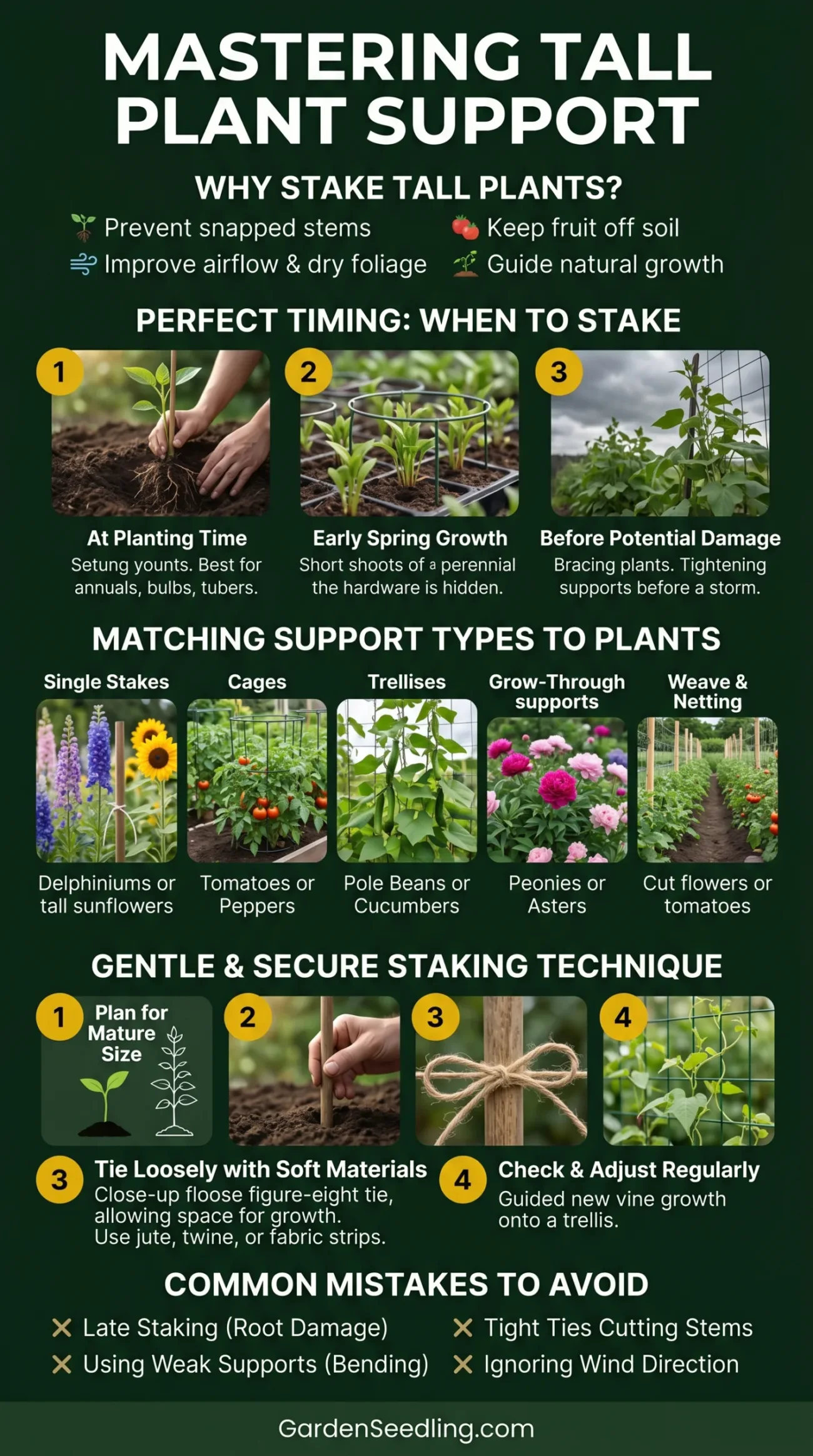
Tall plants do not always fall over because they are weak. Often, they fall because the garden gives them a little too much at once: soft spring growth, summer storms, heavy fruit, wet soil, or flowers that open like small umbrellas after rain. Knowing when to stake tall garden plants helps you keep stems upright without making the bed look stiff or overworked.
- Quick Answer
- Why Tall Garden Plants Need Support
- When to Stake Tall Garden Plants
- Stake at Planting Time for Plants That Will Need It Later
- Stake When New Growth Starts on Perennials
- Stake Before a Storm, Not After the Damage
- Which Garden Plants Usually Need Staking?
- Best Supports for Tall Garden Plants
- Single Stakes
- Cages
- Trellises
- Grow-Through Rings and Grids
- Florida Weave or Basket Weave
- Netting and Horizontal Support
- How to Stake a Tall Plant Without Hurting It
- Step 1: Choose the Support Before the Plant Gets Heavy
- Step 2: Push the Support Deep Enough
- Step 3: Tie Loosely
- Step 4: Adjust During the Season
- Staking Tomatoes, Cucumbers, Beans, and Other Vegetables
- Tomatoes
- Cucumbers
- Pole Beans and Peas
- Peppers and Eggplants
- Staking Tall Flowers and Perennials
- Dahlias
- Peonies
- Sunflowers, Hollyhocks, and Tall Annuals
- Common Mistakes to Avoid
- Practical Tips for Better Plant Support
- FAQ
- When Should I Stake Tall Garden Plants?
- What Is the Best Support for Tall Tomatoes?
- Should I Stake Plants Before or After They Bloom?
- Can Staking Hurt Plants?
- Do Cucumbers Need a Trellis?
- What Can I Use Instead of Plastic Plant Ties?
The best time to add support is usually early, before the plant has leaned, cracked, or tangled with its neighbors. A stake pushed into the soil after the roots have spread can still help, yes, but it can also bruise roots and force stems into awkward positions. Better to prepare first. Then let the plant grow into the support naturally.
Quick Answer
Stake tall garden plants when they are young, before wind, rain, flowers, or fruit pull them sideways. Use single stakes for one main stem, cages for bushy plants, trellises for climbing crops, rings for clump-forming flowers, and netting or a corral system for rows or large plantings. Tie stems loosely, check them often, and avoid tight plastic ties that cut into soft growth.
Why Tall Garden Plants Need Support
Plant support is not only about neatness. It helps prevent snapped stems, muddy fruit, crowded foliage, and the slow lean that makes a garden look tired by midsummer. Some plants stand fine in calm weather, then flop after one heavy rain. That is normal. Wet flowers and fruit get heavier than they look.
Support also improves airflow around leaves. When foliage stays off the soil and dries faster after watering or rain, many common leaf problems have a harder time spreading. It does not make a plant disease-proof. Nothing does. But it helps create better growing conditions.
A good support should do three simple jobs:
- Hold weight without crushing the stem.
- Guide growth while still allowing natural movement.
- Stay anchored when the soil softens after rain.
That last one gets overlooked. A thin bamboo cane may look fine in May, but a loaded tomato or dahlia can pull it sideways in July. The support has to match the full-grown plant, not the cute starter plant in a pot.
When to Stake Tall Garden Plants
Early is best. Not too early in a fussy way, but early enough that the support disappears into the plant as it grows. For many annual flowers, perennials, tomatoes, beans, cucumbers, and dahlias, that means adding the support at planting time or soon after new growth starts.
Stake at Planting Time for Plants That Will Need It Later

Dahlias, gladiolus, tall tomatoes, pole beans, cucumbers, and tall flowering annuals often benefit from support installed right away. The plant may not need it yet, but the soil is open and the roots are small. That makes the job cleaner.
For tubers and bulbs, this matters even more. Push a stake into the soil later and you may hit the underground storage part. Not always, but it happens. With dahlias, place the stake near the planting hole from the start, then tie the main stems as they grow.
Stake When New Growth Starts on Perennials

For tall perennials, add rings, grids, or twiggy supports in early spring when shoots are short. The plant grows through the support, and by bloom time the hardware is mostly hidden. Much nicer. Also less annoying to work around.
Plants such as delphinium, peony, phlox, yarrow, helenium, asters, and tall sedum may not all need staking in every garden. Rich soil, shade, heavy rain, and crowded planting can make them stretch and flop more than expected.
Stake Before a Storm, Not After the Damage

If the forecast calls for strong wind or heavy rain and a tall plant already leans, support it right away. A loose stem can split quickly in wet weather. Once a main stem snaps, staking may hold it upright, but it cannot fully undo the break.
After storm damage, use soft ties and a sturdy stake to hold the stem in a natural position. Do not pull it perfectly straight if the stem has already bent hard. Ease it back. Plants are flexible, but not magic.
Which Garden Plants Usually Need Staking?
Some plants ask for support almost every season. Others only need it when conditions push them too far. A windy site, lush growth from high nitrogen, or heavy watering can turn a usually sturdy plant into a sprawler.
| Plant Type | Best Support | Best Timing | Useful Note |
|---|---|---|---|
| Indeterminate tomatoes | Sturdy cage, stake, trellis, or Florida weave | At planting | Choose a strong support before the plant starts leaning. |
| Dahlias | Single stake, tomato cage, or row corral | At planting | Large blooms and hollow stems need steady support. |
| Pole beans | Teepee, trellis, netting, or poles | At sowing | Give young vines something to grab early. |
| Cucumbers | Trellis, mesh, cattle panel, or A-frame | At planting or soon after | Trellising keeps fruit cleaner and saves ground space. |
| Peonies | Grow-through ring or grid | When shoots are 4–8 inches tall | Blooms get heavy after rain. |
| Delphinium and foxglove | Single stake or discreet cane | Before flower spikes open | Tie loosely at more than one point. |
| Melons on a trellis | Strong trellis plus fruit sling | Support vines early; sling fruit as it swells | Fruit weight can pull vines down. |
Best Supports for Tall Garden Plants
No single support works for everything. A tomato cage is not the right answer for a tall delphinium. A thin stake is not enough for a row of heavy tomatoes. Match the support to the plant’s growth habit first, then think about looks.
Single Stakes
Single stakes work best for plants with one main stem or a clear central leader. Use them for delphiniums, young sunflowers, dahlias, gladiolus, foxglove, lilies, and some peppers or eggplants if they carry heavy fruit.
Wood, bamboo, fiberglass, and metal stakes can all work. The support should be tall enough to reach near the mature height of the plant, but it does not need to stick above the flowers like a flagpole. A little lower often looks better.
- Best for: single-stem plants, flower spikes, top-heavy blooms.
- Avoid: tying one tight band around the stem.
- Use: soft garden twine, fabric strips, jute, or reusable plant ties.
Make a loose figure-eight tie when possible: one loop around the stake, one around the stem. It gives the stem a small cushion instead of rubbing directly against the support.
Cages
Cages work well for plants that grow outward in several directions. Tomatoes are the classic example, but cages can also support tomatillos, ground cherries, peppers, compact dahlias, and bushy flowering annuals.
Choose the cage by plant size. Small cone cages from garden centers may work for peppers or short determinate tomatoes, but tall indeterminate tomatoes often need stronger cages made from heavy wire or a large square-style support. Thin cages bend. They really do.
For tomatoes, install cages at planting time and press the legs deep into the soil. In windy gardens, add a stake beside the cage and tie the cage to it. That one extra step can save a plant during summer storms.
Trellises
Trellises suit plants that climb, twine, or can be trained upward. Use them for pole beans, peas, cucumbers, small melons, climbing nasturtiums, sweet peas, morning glories, and some squash varieties if the fruit is small enough.
A trellis can be flat, arched, A-frame, netted, or made from cattle panel. The shape matters less than strength and access. You should be able to harvest without fighting the vines every time.
- Pole beans: use a teepee, strings, poles, or a tall trellis.
- Cucumbers: use mesh, netting, or a panel with openings large enough for picking.
- Small melons: use a strong trellis and add fabric slings under fruit.
Heavy fruit needs extra help. A melon vine may climb just fine, then fail once the fruit gains weight. Use old T-shirt strips, wide cloth, or soft mesh to make a sling tied to the trellis, not to the vine.
Grow-Through Rings and Grids
Grow-through supports look like rings or grids on short legs. They work beautifully for clumping perennials and bushy flowers that rise from the crown in many stems.
Use them for peonies, asters, phlox, coreopsis, yarrow, balloon flower, tall sedum, and similar plants. Place the ring early, while the stems are still short. Later, the plant hides the support, and the stems stay more evenly spaced.
Late installation is possible, but it turns into a wrestling match. Leaves break. Stems snap. Patience disappears.
Florida Weave or Basket Weave
The Florida weave works well for rows of tomatoes, especially when several plants grow in a straight line. Place sturdy stakes between plants, then run twine along both sides of the row as the plants grow. Each new layer holds the stems upright.
This method uses less hardware than individual cages and makes pruning and harvesting easier in a row. It suits many determinate and semi-determinate tomatoes. For very tall indeterminate tomatoes, use strong stakes and keep adding twine layers before the plants lean.
Netting and Horizontal Support
Horizontal netting can support cut flowers and tall annuals grown in blocks. Zinnias, cosmos, snapdragons, celosia, and stock often grow straighter when they rise through a grid. Flower growers use this method because it supports many stems without tying each one.
For a home garden, one layer of wide mesh stretched between stakes may be enough. Put it in place while plants are still short, then lift or add a second layer as the stems grow.
How to Stake a Tall Plant Without Hurting It
Good staking should feel gentle. The support holds the plant; it does not trap it.
Step 1: Choose the Support Before the Plant Gets Heavy
Think about the mature plant, not the seedling. A tomato that looks tiny in May may need a cage taller than your knee by July. A dahlia that starts as a tuber can turn into a wide, bloom-loaded plant by late summer.
Step 2: Push the Support Deep Enough
A support that wobbles at the base will fail when the top gets heavy. Push stakes several inches into firm soil. In loose raised beds, go deeper. For large plants, use thicker stakes or metal posts.
After watering, check again. Soil settles.
Step 3: Tie Loosely
Leave room for the stem to thicken. A tight tie can cut into the plant, especially on tomatoes, dahlias, sunflowers, and fast-growing annuals. Soft ties are kinder than wire or thin plastic twist ties.
One tie is rarely enough for a tall plant. Add ties as the plant grows, spacing them along the stem. Keep the natural shape. Do not strap every inch to the stake.
Step 4: Adjust During the Season
Plants grow fast in warm weather. Check supports every week or two. Loosen tight ties, add new ones, remove broken stems, and guide vines back onto the trellis.
This is a small job when done early. Left alone, it becomes a messy one.
Staking Tomatoes, Cucumbers, Beans, and Other Vegetables
Vegetable supports should make harvesting easier, not harder. A pretty support that blocks your hands or hides fruit becomes annoying very quickly.
Tomatoes
Indeterminate tomatoes usually need tall, strong support because they keep growing and fruiting through the season. Use sturdy cages, tall stakes, a trellis, or a basket weave. Determinate tomatoes stay shorter, but many still benefit from a cage because fruit clusters can pull branches down.
For staked tomatoes, tie the main stem loosely and prune only as much as your support system requires. For caged tomatoes, guide branches back inside the cage before they sprawl outward. Do it while stems are flexible.
Cucumbers
Vining cucumbers grow well on a trellis. The fruit stays cleaner, the leaves get better airflow, and the plant uses less ground space. Choose a trellis with openings big enough for your hand to reach through.
Bush cucumbers do not need tall support, though a low cage can keep them tidier in small beds.
Pole Beans and Peas
Install supports before or when you sow seeds. Pole beans climb fast once they start. If they have nothing to grab, they twist around nearby plants, hoses, or each other. A teepee, tall netting, or simple stake-and-twine setup works well.
Peas need a lighter support than pole beans, but they still need one early. Tender shoots find the trellis on their own when it is close enough.
Peppers and Eggplants
Not every pepper needs staking. Heavy-fruited plants often do. A small cage or short stake keeps branches from splitting under the weight of fruit, especially after rain or overhead watering.
Eggplants can also lean when fruit gets large. Use one sturdy stake near the main stem and tie loosely below branching points.
Staking Tall Flowers and Perennials
Flower supports should be almost invisible by bloom time. That is the trick.
Dahlias
Dahlias need planning. Many grow tall, branch heavily, and carry large flowers on brittle stems. Use a 4- to 5-foot stake for single plants, a tomato cage for compact varieties, or a row corral with posts and twine for larger plantings.
Start tying when stems are still manageable. Add ties every 12 to 18 inches as the plant grows. For big dinnerplate blooms, support the stem before the flower fully opens.
Peonies
Peonies often stand upright until the flowers open. Then rain arrives, and suddenly the whole plant bows toward the soil. Use grow-through rings early in spring. Once the plant has leafed out, installing a ring is much harder.
Sunflowers, Hollyhocks, and Tall Annuals
Sunflowers usually stand well when grown in full sun and decent soil, but tall types in windy spots may need staking. Hollyhocks also benefit from support in exposed areas. For a natural look, place the stake behind the stem and tie in two or three places.
With cosmos, zinnias, and snapdragons, a horizontal net or low grid often works better than individual stakes, especially if you grow them in a block.
Common Mistakes to Avoid
Most staking problems come from waiting too long or tying too tightly. The rest are usually support-size problems.
- Using weak supports: Thin stakes bend under large tomatoes, dahlias, or heavy vines.
- Tying too tight: Stems thicken as they grow, and tight ties can cut into them.
- Adding supports too late: Late staking can damage roots and break stems.
- Ignoring wind direction: In windy beds, place the support where it can brace the plant against the usual push.
- Letting vines tangle first: Cucumbers, beans, peas, and climbing flowers train better when young.
- Choosing the wrong support: A single stake does not support a wide, bushy plant very well.
Practical Tips for Better Plant Support
Use natural-looking materials when the support will stay visible. Bamboo, wood, jute, and twiggy branches blend into flower beds better than shiny plastic. In vegetable beds, strength matters more than looks, so metal posts, cattle panels, and heavy cages can be worth the space.
Clean reusable supports before the next season, especially if plants had leaf disease. Remove old stems, soil, and plant debris. A clean support is a small thing, but small things stack up in the garden.
For organic gardens, avoid treated wood that may leach unwanted chemicals into soil. Untreated cedar, bamboo, metal, jute, cotton, and reusable garden clips are better choices. Also watch old painted materials. If you do not know what is on them, skip them near edible crops.
One more thing: do not over-stake everything. Some movement helps stems grow stronger. The goal is support, not a garden full of splints.
FAQ
When Should I Stake Tall Garden Plants?
Stake them early, usually at planting time or when new growth is still short. Early support prevents root damage, broken stems, and awkward late-season tying.
What Is the Best Support for Tall Tomatoes?
Indeterminate tomatoes usually need a strong cage, tall stake, trellis, or Florida weave. Small cone cages are often too weak for large plants.
Should I Stake Plants Before or After They Bloom?
Before they bloom. Heavy flowers can pull stems down quickly after rain, so support tall flowers while stems are still upright and flexible.
Can Staking Hurt Plants?
Yes, if the tie is too tight or the stake damages roots. Use soft, loose ties and place supports early to reduce stress on the plant.
Do Cucumbers Need a Trellis?
Vining cucumbers do best with a trellis, especially in small gardens. Bush cucumbers may not need one, though a low support can keep plants tidier.
What Can I Use Instead of Plastic Plant Ties?
Use jute twine, cotton strips, soft fabric, garden tape, or reusable clips. The tie should hold the stem gently without cutting into it.
A tall plant does not need to look tied down to be well supported. Start early, choose the support that matches the plant’s shape, and keep ties loose. The garden will look more relaxed, and the plants will handle wind, rain, fruit, and flowers with far less trouble.