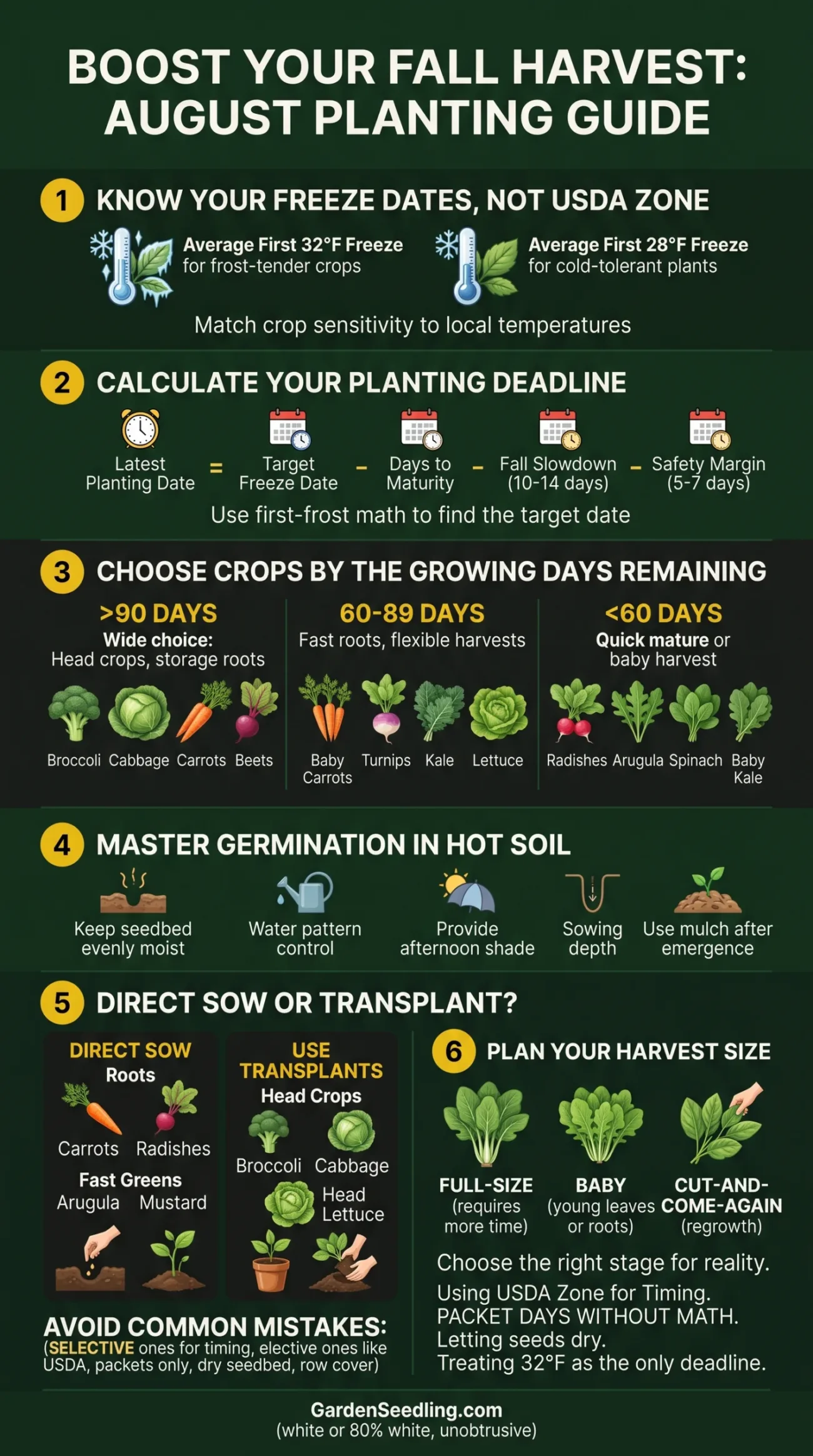
August planting starts with subtraction. The seed packet may say a crop matures in 45 days, yet those 45 days do not tell the whole story when daylight is shrinking, nights are cooling, and the first freeze is moving closer.
- Start With Your First Freeze Date, Not Your USDA Zone
- Use First-Frost Math to Find Your Planting Deadline
- Days to Maturity
- Fall Slowdown Allowance
- Safety Margin
- A Worked Example
- Choose Crops by the Growing Days You Have Left
- When 90 or More Days Remain
- When 60 to 89 Days Remain
- When 35 to 59 Days Remain
- When Fewer Than 35 Days Remain
- August Planting Table
- Early, Mid, and Late August Need Different Crop Choices
- Early August
- Mid-August
- Late August
- Hot Soil Can Stop a Fall Garden Before It Starts
- Keep the Seed Zone Evenly Moist
- Give New Seedlings Temporary Shade
- Direct Sow or Use Transplants?
- Plan the Harvest Size Before You Sow
- Full-Size Harvest
- Baby Harvest
- Cut-and-Come-Again Harvest
- Overwintering
- Use Succession Sowing Without Planting Too Much
- Protect Crops Without Overestimating the Extra Time
- Floating Row Cover
- Low Tunnels
- Cold Frames
- Common August Planting Mistakes
- Using the Hardiness Zone as a Planting Deadline
- Trusting the Packet Number Without Reading the Fine Print
- Skipping the Fall Slowdown Allowance
- Using 32°F as the Final Deadline for Every Vegetable
- Starting Long-Season Brassicas From Seed Too Late
- Letting the Seedbed Dry
- Assuming Row Cover Adds Weeks of Fast Growth
- A Simple August Planting Checklist
- Frequently Asked Questions
- Is August Too Late to Plant a Fall Garden?
- Should I Use My First Frost Date or First Freeze Date?
- How Many Extra Days Should I Add for Fall Growth?
- Can I Plant Carrots in August?
- What Is the Fastest Vegetable to Plant in August?
- Will Row Cover Save Crops From the First Frost?
A useful August planting guide must connect three pieces of information: your local first-freeze dates, the variety’s actual days to maturity, and the plant’s tolerance for cold. Miss one of those, and a crop that looked fast enough on paper may stall a week or two before harvest.
When 60 to 90 usable growing days remain, many fall roots, greens, and transplanted brassicas are still realistic. With 35 to 59 days, shift toward radishes, turnips, leafy greens, baby roots, and fast Asian greens. Below 35 days, focus on baby leaves, very fast radishes, protected crops, or plantings meant to overwinter rather than mature before winter.
The month printed on the calendar is only the starting point. Early August in Minnesota and late August in Georgia describe very different growing windows. Your garden’s remaining days decide what belongs in the soil.
Start With Your First Freeze Date, Not Your USDA Zone
A USDA Plant Hardiness Zone helps describe the average lowest winter temperatures in an area. It does not tell you when the first autumn freeze will arrive. Two gardens in the same zone may have noticeably different fall planting deadlines because of elevation, nearby water, urban heat, cold-air drainage, and local terrain.
For late-season vegetables, look for two local dates:
- Average first 32°F freeze: Use this as the main deadline for frost-tender crops such as bush beans, cucumbers, summer squash, and basil.
- Average first 28°F freeze: This later date can be more useful for cold-tolerant greens, roots, and brassicas that often survive a light freeze.
Neither date is a promise. An average first freeze is a probability based on past weather records, not a scheduled event. A cold front can arrive early. A mild fall may give you extra weeks.
Do not use one freeze date for every crop. A bean plant and a kale plant may be growing side by side, but the first cold night will not affect them equally. Beans can suffer at the first frost. Established kale often continues producing through several colder nights.
Use First-Frost Math to Find Your Planting Deadline
The basic calculation is simple:
Latest Planting Date = Target Freeze Date − Days to Maturity − Fall Slowdown Allowance − Safety Margin
The result gives you a planning deadline, not a guarantee. Germination speed, soil moisture, pest damage, shade, and unexpected weather can still move the harvest date.
Days to Maturity
Use the number printed for the exact variety you plan to grow. A generic crop chart may list carrots at 60 to 80 days, but an early baby carrot and a storage carrot can differ by several weeks.
Also check when the countdown begins. This small detail causes plenty of late-season mistakes.
- For many direct-sown crops, maturity starts from sowing or seedling emergence.
- For many transplanted crops, maturity starts when the established seedling enters the garden.
- Some seed catalogs give one number for baby harvest and another for full-size harvest.
If a broccoli variety needs 60 days from transplanting, the time spent growing indoors happened before those 60 days. If you are starting that broccoli from seed in August, you must add the seedling period as well.
Fall Slowdown Allowance
Vegetables often grow more slowly as autumn approaches. Shorter days reduce the amount of light available for growth, even when daytime temperatures remain pleasant.
Add about 10 to 14 days to the listed maturity period for many late-summer sowings. Fast crops planted in a warm southern climate may need a smaller allowance. Long-season crops approaching cold weather may need more.
Not exact, this part. It is a practical buffer for slower fall growth.
Safety Margin
Add another 5 to 7 days when a reliable harvest matters. This covers slightly slow germination, a cloudy week, minor insect damage, or a brief dry spell.
A gardener willing to accept some risk can use a smaller margin. For a crop intended for storage or a full family harvest, leave more room.
A Worked Example
Suppose your average first 32°F freeze is October 15. You want to plant a frost-tender bush bean that lists 50 days to maturity.
- Days to maturity: 50 days
- Fall slowdown allowance: 14 days
- Safety margin: 7 days
- Total time needed: 71 days
Counting back 71 days from October 15 gives a planting deadline near August 5. Planting on August 15 may still produce a few beans in a warm fall, but a full harvest becomes much less dependable.
Now consider a cold-tolerant crop. If a fast turnip can remain in the garden beyond the first light frost, use a later cold threshold instead of automatically stopping the calculation at 32°F.
Choose Crops by the Growing Days You Have Left
The following groups work better than a broad zone-based planting list. First calculate your usable growing window, then compare it with the exact variety label.
When 90 or More Days Remain
A long remaining season gives you the widest choice, including crops that need time to form heads, thick stems, or storage-size roots.
- Broccoli transplants
- Cabbage transplants
- Cauliflower transplants
- Kale and collard transplants
- Carrots
- Beets
- Rutabagas
- Turnips
- Kohlrabi
- Swiss chard
In climates with a late first freeze, early August may also allow a final planting of fast bush beans, cucumbers, or summer squash. These remain risky because they cannot rely on cold tolerance to extend the harvest window.
When 60 to 89 Days Remain
This is a productive range for fall vegetables. Fast roots and leafy crops have enough time to size up, while purchased brassica transplants may still form a usable harvest.
- Beets
- Baby or medium-size carrots
- Turnips
- Kohlrabi
- Kale
- Collards
- Swiss chard
- Mustard greens
- Tatsoi, mizuna, and bok choy
- Leaf lettuce
- Fast bush beans in suitable climates
Pay attention to the harvest goal. A carrot variety that cannot reach its full listed size may still produce sweet, usable baby roots. That changes the calculation.
When 35 to 59 Days Remain
Use crops that mature quickly or can be harvested before full size.
- Radishes
- Arugula
- Mustard greens
- Baby kale
- Baby leaf lettuce
- Spinach
- Turnip greens
- Beet greens
- Mizuna
- Tatsoi
- Cilantro
- Green onions grown from sets
A mixed planting works well here. Radishes can come out first, followed by baby greens, then slower turnips or beets if the weather holds.
When Fewer Than 35 Days Remain
Full-size harvests become less dependable, but the bed is not useless.
- Baby arugula
- Baby mustard greens
- Pea shoots
- Very fast radishes
- Baby lettuce
- Young turnip greens
- Microgreens grown in containers
- Spinach planted for overwintering
- Cold-frame greens
At this point, decide whether you want an autumn harvest or a crop that will establish roots, pause during the coldest period, and resume growing later. Those are different plans.
August Planting Table
Days to maturity vary by variety and may begin at sowing or transplanting. Treat the ranges below as a sorting tool, then follow the seed packet for your final calculation.
| Crop | Best Method | Typical Maturity Range | Cold Response | Useful Backup Harvest | Main August Problem |
|---|---|---|---|---|---|
| Radish | Direct sow | 22–40 days | Tolerates cool weather and light frost | Young greens | Heat can cause poor roots or strong flavor |
| Arugula | Direct sow | 20–40 days | Handles light frost | Baby leaves | Hot, dry soil slows emergence |
| Leaf Lettuce | Direct sow or transplant | 30–55 days | Tolerates cool weather; hard freezes can damage leaves | Baby leaf harvest | Poor germination in hot soil |
| Spinach | Direct sow | 35–50 days | Cold-hardy after establishment | Overwinter for later harvest | Seed may germinate poorly in hot soil |
| Turnip | Direct sow | 35–60 days | Tolerates light frost | Greens or small roots | Crowding prevents root formation |
| Beet | Direct sow | 50–70 days | Tolerates light frost | Beet greens or baby roots | Slow or uneven emergence in dry soil |
| Carrot | Direct sow | 55–80 days | Established roots tolerate cool weather | Baby carrots | Surface soil dries before seedlings emerge |
| Kale | Direct sow or transplant | 45–75 days | Cold-hardy | Baby leaves | Flea beetles, caterpillars, and heat stress |
| Broccoli | Transplant preferred | 50–80 days from transplant | Tolerates light frost | Side shoots after the main head | Late planting may produce leaves but no full head |
| Bush Bean | Direct sow | 45–60 days | Frost-tender | None if frost arrives before pods form | Early frost ends production |
Early, Mid, and Late August Need Different Crop Choices
August is not one planting window. Losing two weeks can remove an entire crop group from the realistic list.
Early August
Early August offers the best chance for full-size fall roots and transplanted brassicas. In long-season regions, a final sowing of quick bush beans or summer squash may also work.
Useful choices often include carrots, beets, turnips, rutabagas, kohlrabi, kale, collards, Swiss chard, broccoli transplants, and cabbage transplants.
Mid-August
By mid-month, favor faster varieties and flexible harvests. Baby roots become more dependable than large storage roots.
Good options may include turnips, beets, radishes, kale, mustard greens, Asian greens, leaf lettuce, Swiss chard, and cilantro. Spinach can work where soil temperatures have begun to fall.
Late August
Late August favors leaves.
Plant radishes, arugula, mustard greens, baby kale, mizuna, tatsoi, spinach, and leaf lettuce where enough cool growing time remains. In mild climates, late August may still behave more like midsummer, so delay heat-sensitive seeds or start them under shade.
Hot Soil Can Stop a Fall Garden Before It Starts
The odd part of fall planting is that cool-season vegetables must first survive summer conditions. Lettuce, spinach, carrots, and small-seeded greens can fail while the weather still feels far too warm for frost calculations to matter.
Near the soil surface, heat and drying happen quickly. A seed may absorb water in the morning, begin germination, then dry by late afternoon. Once that process starts, repeated drying can kill the seed.
Keep the Seed Zone Evenly Moist
- Water before sowing: Moisten the bed deeply rather than planting into powdery soil.
- Sow at the correct depth: Tiny seeds buried too deeply may never reach the surface.
- Use a fine watering pattern: A hard stream can expose seeds or form a crust over them.
- Check the bed daily: The upper half-inch may dry while the soil below still feels damp.
- Mulch only after emergence: Heavy mulch over tiny seeds can block seedlings.
Give New Seedlings Temporary Shade
Light shade during the hottest part of the afternoon can improve establishment. Use shade cloth, an elevated board, or the eastern side of a taller crop. Keep the cover above the soil so air can move underneath.
Remove or reduce shade after seedlings establish. Fall crops still need enough light to grow before the days shorten further.
The August paradox: You are planting for cool autumn weather, but the seeds must first make it through warm soil, intense sun, and fast evaporation.
Direct Sow or Use Transplants?
The right method can save several weeks. It can also prevent root damage.
| Crop Type | Better August Method | Reason |
|---|---|---|
| Carrots, radishes, turnips | Direct sow | Transplanting can disturb or deform developing roots. |
| Broccoli, cabbage, cauliflower | Use healthy transplants when time is short | Established seedlings provide several weeks of growth before entering the bed. |
| Arugula, mustard, baby lettuce | Direct sow | They grow quickly and do not need a long indoor start. |
| Head lettuce | Transplant or direct sow under shade | Controlled temperatures can improve germination during hot weather. |
| Bush beans | Direct sow | Beans establish quickly but need enough frost-free time to produce pods. |
Do not buy an overgrown brassica transplant simply because it looks large. Root-bound, stretched, or heat-stressed plants may pause after planting. A compact seedling with several healthy leaves usually establishes more smoothly.
Plan the Harvest Size Before You Sow
Days to maturity usually describe a particular stage. That stage may be a full head, a mature root, the first bean picking, or a baby leaf. Choosing the stage before planting can turn a doubtful crop into a realistic one.
Full-Size Harvest
Use the complete maturity period, then add the fall slowdown and safety margin. This target suits storage carrots, mature beets, cabbage heads, broccoli heads, and other crops where size matters.
Baby Harvest
Young leaves and small roots often become usable well before the listed maturity date. Baby kale, beet greens, turnip greens, small carrots, and loose-leaf lettuce can fill gaps when full maturity no longer fits the calendar.
Small does not mean failed. It means planned differently.
Cut-and-Come-Again Harvest
Arugula, mustard, leaf lettuce, mizuna, and some kale varieties can regrow after a careful cutting. Harvest above the growing point and leave enough leaf tissue for recovery.
Late in the season, the second cutting may grow slowly. Make the first harvest worthwhile rather than counting on several heavy rounds.
Overwintering
Spinach and a few hardy greens can establish in fall, survive winter under suitable conditions, and resume growth as days lengthen. Success depends on climate, drainage, plant size, snow cover, and protection.
Do not count an overwintering crop as an autumn harvest unless enough time remains for usable leaves before growth nearly stops.
Use Succession Sowing Without Planting Too Much
One large sowing of radishes or lettuce can produce more than you can use at once. Smaller batches spread the harvest and reduce the chance that one hot week ruins the entire planting.
For fast crops, sow a short row every 7 to 14 days. Recalculate before each round.
- First sowing: Aim for a full-size harvest.
- Second sowing: Accept medium roots or smaller leaves.
- Final sowing: Plan for baby greens, protection, or overwintering.
Stop when the math no longer fits your chosen harvest stage. Planting more seed does not create more growing days.
Protect Crops Without Overestimating the Extra Time
Row cover, low tunnels, and cold frames can protect leaves from wind and light freezes. They can also exclude flea beetles, cabbage moths, and other insects when installed early.
Protection does not return summer growth rates. A covered plant may stay alive while producing very little new growth during short, dim days.
Floating Row Cover
Lay lightweight fabric over newly planted brassicas and greens to reduce insect damage. Leave slack for growth and seal the edges with soil, boards, or landscape staples.
For crops that need insect pollination, remove the cover when flowering begins. Most fall greens and root crops do not need pollinators before harvest.
Low Tunnels
Hoops keep fabric or plastic above the leaves and create a larger protected space. Vent plastic-covered tunnels on warm sunny days. Temperatures can climb quickly, even when the air outside feels mild.
Cold Frames
A cold frame works well for lettuce, spinach, Asian greens, and compact herbs. Place taller crops toward the back so they do not shade shorter seedlings.
Open the lid during warm weather and close it before temperatures fall in the evening. Easy to forget, that last part.
Common August Planting Mistakes
Using the Hardiness Zone as a Planting Deadline
The zone describes winter low temperatures, not the arrival date of autumn frost. Use local freeze records for timing.
Trusting the Packet Number Without Reading the Fine Print
Check whether maturity begins at sowing, emergence, or transplanting. Also check whether the number describes baby leaves or a mature crop.
Skipping the Fall Slowdown Allowance
A 50-day crop planted in August may not behave like the same crop planted in May. Add time for shorter days and cooling weather.
Using 32°F as the Final Deadline for Every Vegetable
Cold-hardy crops may keep growing after a light frost. Tender crops may not. Match the deadline to the plant.
Starting Long-Season Brassicas From Seed Too Late
A crop listed at 65 days from transplant may also need several weeks indoors before transplanting. Add both periods when starting from seed.
Letting the Seedbed Dry
Fall crops often fail during germination, not during frost. Keep the shallow seed zone moist until seedlings emerge and establish roots.
Assuming Row Cover Adds Weeks of Fast Growth
Cover can reduce cold injury. It cannot replace daylight.
A Simple August Planting Checklist
- Find your local average first 32°F freeze date.
- Find the average first 28°F freeze date.
- Choose the temperature threshold that matches the crop.
- Read the exact variety’s days to maturity.
- Confirm when the maturity countdown begins.
- Add 10 to 14 days for slower fall growth.
- Add a 5- to 7-day safety margin when needed.
- Decide whether you want baby, full-size, or overwintered growth.
- Count backward to find the latest planting date.
- Prepare shade and steady moisture for hot-weather germination.
When the calculated date has already passed, change one part of the plan. Choose a faster variety, use a transplant, harvest at a younger stage, add protection, or switch to another crop.
Frequently Asked Questions
Is August Too Late to Plant a Fall Garden?
No. Many greens, radishes, turnips, beets, carrots, and transplanted brassicas can still produce a fall harvest. The workable choices depend on the number of growing days left before local freezing temperatures.
Should I Use My First Frost Date or First Freeze Date?
Use a temperature-based freeze date when possible. The first 32°F date helps with tender crops, while cold-tolerant vegetables may remain productive until colder weather arrives.
How Many Extra Days Should I Add for Fall Growth?
Adding 10 to 14 days works as a practical starting point for many crops. Adjust for your climate, planting date, variety, sunlight, and harvest goal.
Can I Plant Carrots in August?
Yes, where enough growing time remains. Keep the seedbed evenly moist because carrot seedlings emerge slowly, and consider a fast or baby variety when the season is tight.
What Is the Fastest Vegetable to Plant in August?
Radishes and baby leafy greens are among the fastest choices. Some arugula, mustard, and lettuce varieties can provide young leaves within a few weeks.
Will Row Cover Save Crops From the First Frost?
It can reduce injury from a light frost, depending on the fabric, wind, moisture, and temperature. It will not protect every crop from every freeze, and it does not prevent growth from slowing as daylight decreases.
The best August crop is not simply the one with the shortest maturity number. Choose the crop whose planting method, harvest stage, and cold tolerance fit the days your garden actually has left.