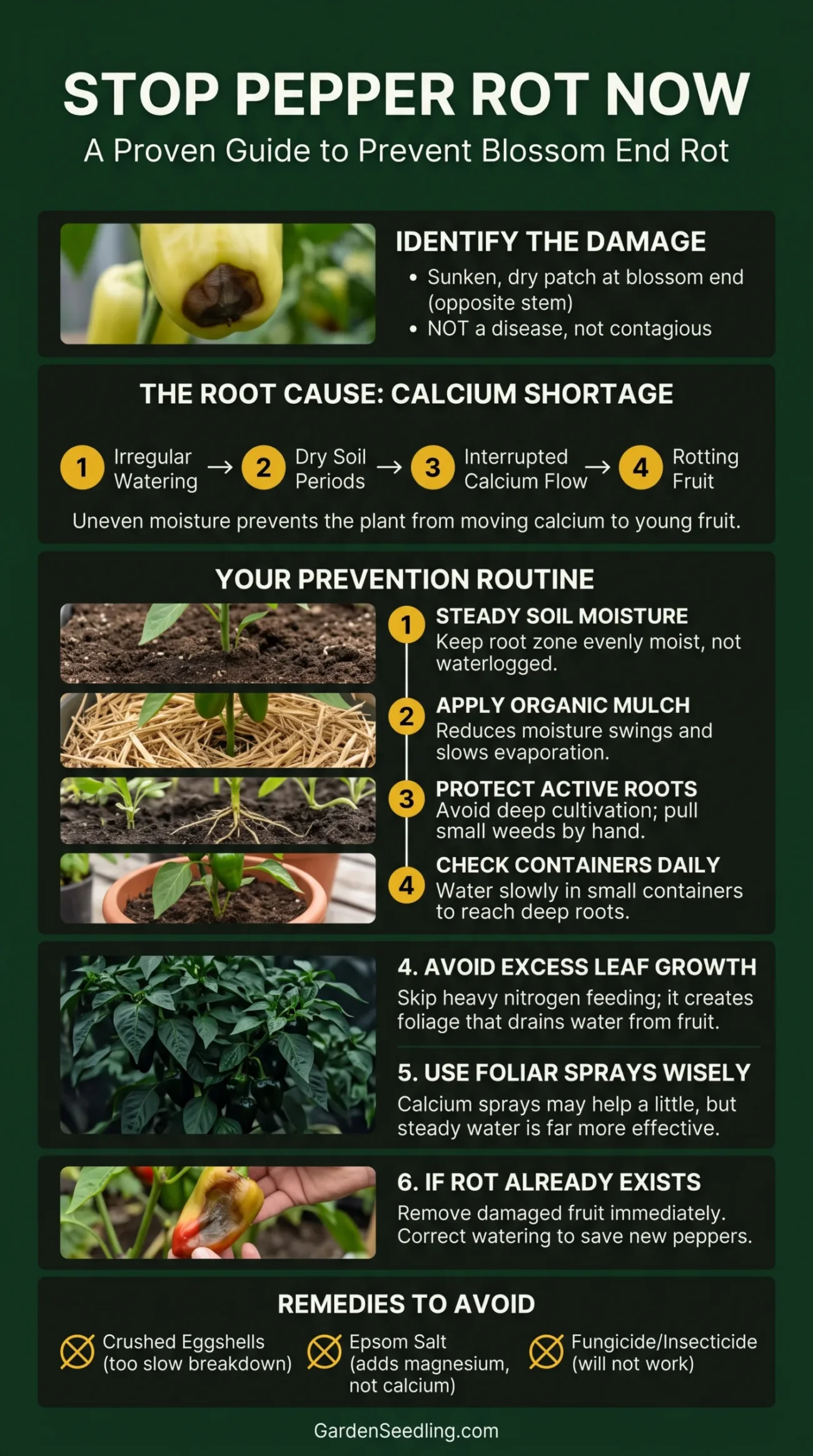
A pepper can look healthy from leaf tip to stem and still produce a fruit with a dark, sunken patch at the bottom. That damage is blossom end rot. It is not a fungal disease, it does not spread from fruit to fruit, and spraying the plant with a pesticide will not stop it.
- Why Peppers Get Blossom End Rot
- Confirm That the Damage Is Blossom End Rot
- Typical Symptoms on Pepper Fruit
- Blossom End Rot Compared With Other Pepper Problems
- Keep Soil Moisture Steady
- Check Moisture Below the Surface
- Avoid Shallow Sprinkling
- Use Drip Irrigation Carefully
- Use Mulch to Slow Moisture Swings
- Protect Pepper Roots
- Keep Cultivation Shallow
- Prevent Waterlogged Soil
- Avoid Fertilizer Burn
- Do Not Add Calcium Without Checking the Soil
- Feed Pepper Plants Without Pushing Excess Leaf Growth
- Be Careful With Ammonium-Heavy Fertilizers
- Prevent Blossom End Rot in Container Peppers
- Choose Enough Container Volume
- Use Potting Mix, Not Dense Garden Soil
- Check Containers Daily During Hot Weather
- Prepare Pepper Plants for Heat, Wind, and Heavy Rain
- Before Hot Weather
- After Heavy Rain
- What to Do When a Pepper Already Has Blossom End Rot
- Why Common Home Remedies Often Disappoint
- Crushed Eggshells
- Epsom Salt
- Calcium Foliar Sprays
- Extra Water Every Day
- A Blossom End Rot Prevention Routine
- Before Planting
- After Transplanting
- During Flowering and Early Fruit Growth
- When Fruit Begins to Size Up
- Frequently Asked Questions
- Can a Pepper With Blossom End Rot Recover?
- Can You Eat a Pepper With Blossom End Rot?
- Does Blossom End Rot Spread to Other Plants?
- Should You Add Lime Around Pepper Plants?
- Why Do Only the First Peppers Have Blossom End Rot?
- Why Do My Potted Peppers Keep Getting Blossom End Rot?
Blossom end rot develops when a young pepper fruit does not receive enough calcium while its cells are expanding. Often, the soil already contains calcium. The trouble starts when irregular watering, damaged roots, excess fertilizer, poor drainage, or fast drying prevents the plant from moving that calcium into the fruit at the right time.
For most home gardens, prevention starts with steady soil moisture. Keep the root zone evenly moist but never waterlogged, protect the roots, avoid heavy nitrogen feeding, and use a soil test before adding lime or other calcium products. A damaged pepper will not repair itself, but later fruit may grow normally once the stress is corrected.
Why Peppers Get Blossom End Rot
Calcium does not simply sit in the soil and wait for a pepper to use it. It must dissolve in soil water, enter active roots, and move upward with the plant’s water supply. When that flow slows or stops, a fast-growing fruit may run short even though nearby leaves still look green.
The blossom end—the end opposite the stem—is usually the first part to show damage. Cells there are expanding quickly, and calcium does not move easily from older leaves into a developing fruit later. Timing matters. A brief dry spell during early fruit growth can leave damage that becomes visible several days afterward.
| What the Plant Needs | What Can Interrupt It |
|---|---|
| Moist soil around active roots | Soil that swings from very dry to soaked |
| Air in the root zone | Standing water, compacted soil, or blocked drainage |
| Healthy water movement | Root damage, fertilizer salts, heat, or strong wind |
| Balanced plant growth | Excess nitrogen that pushes lush leaf growth |
A useful way to picture the process is:
Break any link in that chain, and blossom end rot becomes more likely.
Confirm That the Damage Is Blossom End Rot
Before changing the soil or adding fertilizer, look closely at where the damaged area begins. Blossom end rot normally starts at the flower end of the pepper, not beside the stem.
Typical Symptoms on Pepper Fruit
- Location: The patch begins at or near the bottom of the fruit, opposite the stem.
- Early appearance: The tissue may look pale, water-soaked, tan, or slightly translucent.
- Later appearance: The area becomes brown or black, dry, leathery, and sunken.
- Progression: The patch may spread across a larger part of the fruit as it grows.
- Secondary decay: Mold or soft rot may move into the damaged tissue later, especially in humid weather.
Damage can appear on bell peppers, jalapeños, banana peppers, poblanos, and other types. Large-fruited peppers may show it more often because their developing fruit places a heavier demand on the plant’s water and mineral supply.
Blossom End Rot Compared With Other Pepper Problems
| Problem | Usual Location | Appearance | Helpful Clue |
|---|---|---|---|
| Blossom end rot | End opposite the stem | Sunken, brown or black, often dry | Starts at the blossom end while fruit is developing |
| Sunscald | Sun-exposed side | Pale, white, tan, or papery | Follows strong sun exposure, often where foliage is sparse |
| Anthracnose | Any part of the fruit | Round, sunken spots that may develop orange or pink spore masses | Several distinct lesions may appear |
| Insect feeding | Variable | Holes, scars, chewing marks, or distorted tissue | Look for entry holes, frass, or feeding damage |
Keep Soil Moisture Steady
This is the main job. Not constantly wet soil—steady soil.
A common pattern goes like this: the garden dries hard for several days, pepper leaves begin to droop, and then the bed receives a heavy soaking. The roots move from drought stress to saturated soil in a matter of hours. Repeating that cycle makes calcium delivery unreliable.
Check Moisture Below the Surface
The top half-inch of soil can look dry while the root zone remains moist. On the other hand, a quick sprinkle may darken the surface without reaching the deeper roots. Check the soil two or three inches down with a finger, a wooden skewer, or a small hand trowel.
Water when the upper root zone has begun to dry but before the entire bed turns dusty or the plant repeatedly wilts. Apply water slowly enough to soak the soil around the roots. Then pause. More water is not always better.
Avoid Shallow Sprinkling
Frequent light watering encourages roots to stay close to the surface, where heat and wind dry the soil quickly. A deeper watering helps roots use a larger volume of soil. The exact schedule will vary with weather, soil texture, plant size, and whether the peppers grow in the ground or in containers.
- Sandy soil: Check more often because water drains quickly.
- Clay soil: Water more slowly and allow time for drainage.
- Raised beds: Watch the edges, which often dry before the center.
- Hot, windy sites: Expect faster moisture loss from both soil and leaves.
- Mulched beds: Lift the mulch and test the soil beneath it before watering.
Use Drip Irrigation Carefully
Drip tubing and soaker hoses can keep leaves dry and place water near the roots, but they still need checking. A clogged emitter can leave one pepper dry while the rest of the row looks fine. In heavy soil, running the system too long may create a soaked pocket around the plant.
After watering, dig a narrow test hole several inches from the stem. The wet area should reach through the active root zone, not form a tiny damp circle on the surface.
Use Mulch to Slow Moisture Swings
Organic mulch works like a lid with small air gaps. It slows evaporation, softens soil temperature changes, and reduces the sharp wet-dry swings that trouble pepper plants.
Apply shredded leaves, clean straw, untreated grass clippings, or another suitable garden mulch after the soil has warmed. A layer around two to three inches deep works in many beds. Leave a little open space around the stem so the base of the plant does not stay constantly damp.
Do not let mulch hide a watering problem.
The surface may look dry while the soil underneath is still wet. Always check beneath the mulch before turning on the hose.
Protect Pepper Roots
Healthy roots move water. Damaged roots do not, even when the soil contains plenty of moisture and calcium.
Keep Cultivation Shallow
Pepper roots spread through the upper soil layers. Deep hoeing near the plant can cut those roots and briefly interrupt water uptake. Pull small weeds by hand, slice them at the surface, or cover the bed with mulch before weeds become established.
Prevent Waterlogged Soil
When soil stays saturated, roots lose access to oxygen. The plant may wilt even though the ground looks wet—a confusing sight, yes, but common in poorly drained beds.
Watch for these warning signs:
- Water remains on the surface long after irrigation.
- The soil smells sour or stagnant.
- Lower leaves yellow while the bed stays wet.
- Roots appear brown, soft, or sparse rather than pale and firm.
- The same area develops blossom end rot after every heavy rain.
Adding calcium will not repair poor drainage. Improve the soil structure with organic matter over time, grow peppers in raised beds, or move container plants out of standing water.
Avoid Fertilizer Burn
Concentrated fertilizer placed against roots can pull water away from root tissue and leave salt damage. Never pour a strong liquid feed onto bone-dry potting mix. Water lightly first, follow the product label, and resist combining several fertilizers because each one looks harmless on its own.
Do Not Add Calcium Without Checking the Soil
Blossom end rot is related to calcium inside the fruit, but that does not prove the garden soil lacks calcium. In many home gardens, uneven water movement causes the problem while soil calcium remains adequate.
A soil test can show calcium levels, pH, and other nutrient conditions. That matters because common calcium amendments behave differently.
| Amendment | What It Does | Why Guessing Can Cause Trouble |
|---|---|---|
| Garden lime | Adds calcium and raises soil pH | Too much can push pH above the range peppers prefer |
| Dolomitic lime | Adds calcium and magnesium while raising pH | Unneeded magnesium may disturb nutrient balance |
| Gypsum | Adds calcium with little direct effect on pH | It will not fix every drainage, compaction, or soil texture problem |
When a soil test shows adequate calcium and a suitable pH, focus on irrigation, drainage, root health, and fertilizer use. Those are usually the better places to look.
Feed Pepper Plants Without Pushing Excess Leaf Growth
Peppers need nutrients, but heavy feeding can make blossom end rot harder to control. High nitrogen levels encourage fast, leafy growth. Those leaves draw water, and the plant may struggle to supply expanding fruit during hot or dry periods.
Possible signs of excess nitrogen include:
- Very dark green foliage with soft, fast-growing stems
- A large plant with few flowers or poor fruit set
- Repeated feeding even though growth already looks vigorous
- Heavy use of lawn-type fertilizer near the vegetable bed
Use fertilizer according to a soil test or a label written for vegetables. Once flowering begins, avoid trying to force growth with frequent high-nitrogen applications. Balanced, moderate feeding is easier on the roots.
Be Careful With Ammonium-Heavy Fertilizers
Large amounts of ammonium nitrogen can interfere with calcium uptake. Home gardeners rarely need to calculate every nitrogen form, but the label can still help. Avoid repeatedly stacking ammonium-based fertilizers, manure products, and liquid feeds around the same plants.
Prevent Blossom End Rot in Container Peppers
Container-grown peppers face a tighter margin for error. A pot may dry during one hot afternoon, especially when it sits on concrete, a deck, or a south-facing wall.
Choose Enough Container Volume
A container around five gallons is a practical starting size for one pepper plant. Larger bell pepper varieties often benefit from more room. Small pots hold less water, heat faster, and fill with roots sooner—three conditions that make moisture harder to manage.
Use Potting Mix, Not Dense Garden Soil
Garden soil can compact inside a container and drain poorly. Use a potting mix made for containers, with enough coarse material to hold air around the roots. Make sure every drainage hole remains open.
Check Containers Daily During Hot Weather
Check daily does not always mean water daily. Feel the mix below the surface and lift smaller pots to judge their weight. If water runs straight down the sides of a very dry pot, apply it in two slow passes. The first pass moistens the mix; the second reaches deeper.
| Container Condition | Better Response |
|---|---|
| Pot feels very light and mix pulls from the sides | Water slowly in two or three passes |
| Water stands in the saucer | Empty the saucer and check the drainage holes |
| Pot becomes hot to the touch | Move it away from reflected heat or shade the container itself |
| Roots circle densely around the pot | Move the plant to a larger container when practical |
Prepare Pepper Plants for Heat, Wind, and Heavy Rain
Weather changes the speed at which water moves through a pepper plant. A watering routine that works in mild weather may fail during a hot, windy week.
Before Hot Weather
- Check that drip emitters and hoses work evenly.
- Water deeply before the soil becomes dry and hard.
- Refresh thin mulch where the soil is exposed.
- Move pots away from heat-reflecting pavement when possible.
- Skip heavy fertilizer applications just before a heat wave.
After Heavy Rain
Turn off automatic irrigation until the root zone begins to drain. The soil surface may dry while deeper layers remain saturated, especially in clay beds and large containers. Dig a small test hole rather than trusting appearances.
Then comes the tricky part: heavy rain followed by hot sun. Soil can shift from soaked to dry surprisingly fast near the surface, so keep checking rather than returning immediately to the old timer schedule.
What to Do When a Pepper Already Has Blossom End Rot
The damaged tissue will not become healthy again. Still, the plant itself may continue producing usable peppers.
- Check the lesion location. Make sure the patch starts at the blossom end rather than the sun-facing side.
- Inspect several fruits. One injured pepper does not always represent the whole plant.
- Remove badly damaged fruit. This also makes it easier to monitor new fruit.
- Check soil moisture before watering. Do not react with an automatic heavy soaking.
- Review the previous week. Look for missed watering, extreme heat, heavy rain, a clogged emitter, or a dried-out pot.
- Inspect drainage. Make sure water can leave the root zone.
- Review recent fertilizer use. Pause extra feeding if the plant already looks lush.
- Watch newly forming peppers. Improvement appears in later fruit, not in the original damaged patch.
Do not spray fungicide or insecticide for blossom end rot.
The disorder is not caused by a fungus or insect. Secondary mold may grow on damaged tissue later, but it did not cause the original sunken patch.
Why Common Home Remedies Often Disappoint
Crushed Eggshells
Eggshells contain calcium, but they break down slowly in garden soil. They cannot quickly repair a water-transport problem inside a developing pepper. Add clean crushed shells to compost if desired, but do not treat them as an emergency cure.

Epsom Salt
Epsom salt supplies magnesium and sulfur, not calcium. Applying it without evidence of a magnesium shortage may create another nutrient imbalance. It also does nothing to steady soil moisture.
Calcium Foliar Sprays
Leaves may absorb a small amount of sprayed calcium, yet calcium does not move freely from mature leaves into pepper fruit. Sprays cannot replace healthy roots and even moisture. When a plant improves after spraying, a change in watering or weather may deserve the credit.
Extra Water Every Day
More water can make matters worse in dense soil or a container with blocked drainage. The goal is not maximum moisture. The goal is a root zone that stays damp enough for uptake while still holding air.
A Blossom End Rot Prevention Routine
Before Planting
- Choose a site with good drainage and at least six hours of direct sun.
- Test the soil when pH or nutrient levels are unknown.
- Add mature compost to improve water-holding and drainage behavior.
- Set up drip irrigation or a soaker hose before plants become large.
- Use roomy containers with open drainage holes.
After Transplanting
- Water the root ball and nearby soil evenly.
- Do not bury concentrated fertilizer against the roots.
- Keep cultivation shallow.
- Add mulch after the soil warms.
- Check that water reaches below the surface.
During Flowering and Early Fruit Growth
- Do not allow repeated wilting.
- Adjust watering for heat, wind, and rain.
- Check container peppers more often than in-ground plants.
- Avoid heavy nitrogen feeding.
- Inspect the blossom end of small fruits once or twice a week.
When Fruit Begins to Size Up
- Keep moisture steady as the peppers expand.
- Make sure mulch has not blocked water from reaching the soil.
- Check emitters for clogs.
- Remove severely damaged fruit.
- Judge recovery by the condition of newer peppers.
Frequently Asked Questions
Can a Pepper With Blossom End Rot Recover?
The damaged area will not heal. You can remove the fruit and correct the growing conditions so later peppers have a better chance of developing normally.
Can You Eat a Pepper With Blossom End Rot?
A pepper with a small, dry patch may be usable after cutting away the damaged tissue. Discard fruit that smells bad, feels slimy, shows spreading mold, or has extensive internal decay.
Does Blossom End Rot Spread to Other Plants?
No. It is a physiological disorder, not a contagious disease. Several plants may develop it at the same time because they share the same watering, soil, or weather stress.
Should You Add Lime Around Pepper Plants?
Only when a soil test shows low pH or a need for lime. Adding it without testing may raise the pH too far and make other nutrients harder for peppers to use.
Why Do Only the First Peppers Have Blossom End Rot?
Early fruit may develop while roots are still establishing or while spring weather swings between wet and dry. Later fruit can improve as the root system grows and moisture becomes steadier.
Why Do My Potted Peppers Keep Getting Blossom End Rot?
The container may be too small, drying too quickly, overheating, or draining poorly. Check root space, potting mix, drainage holes, reflected heat, and moisture below the surface before adding calcium.