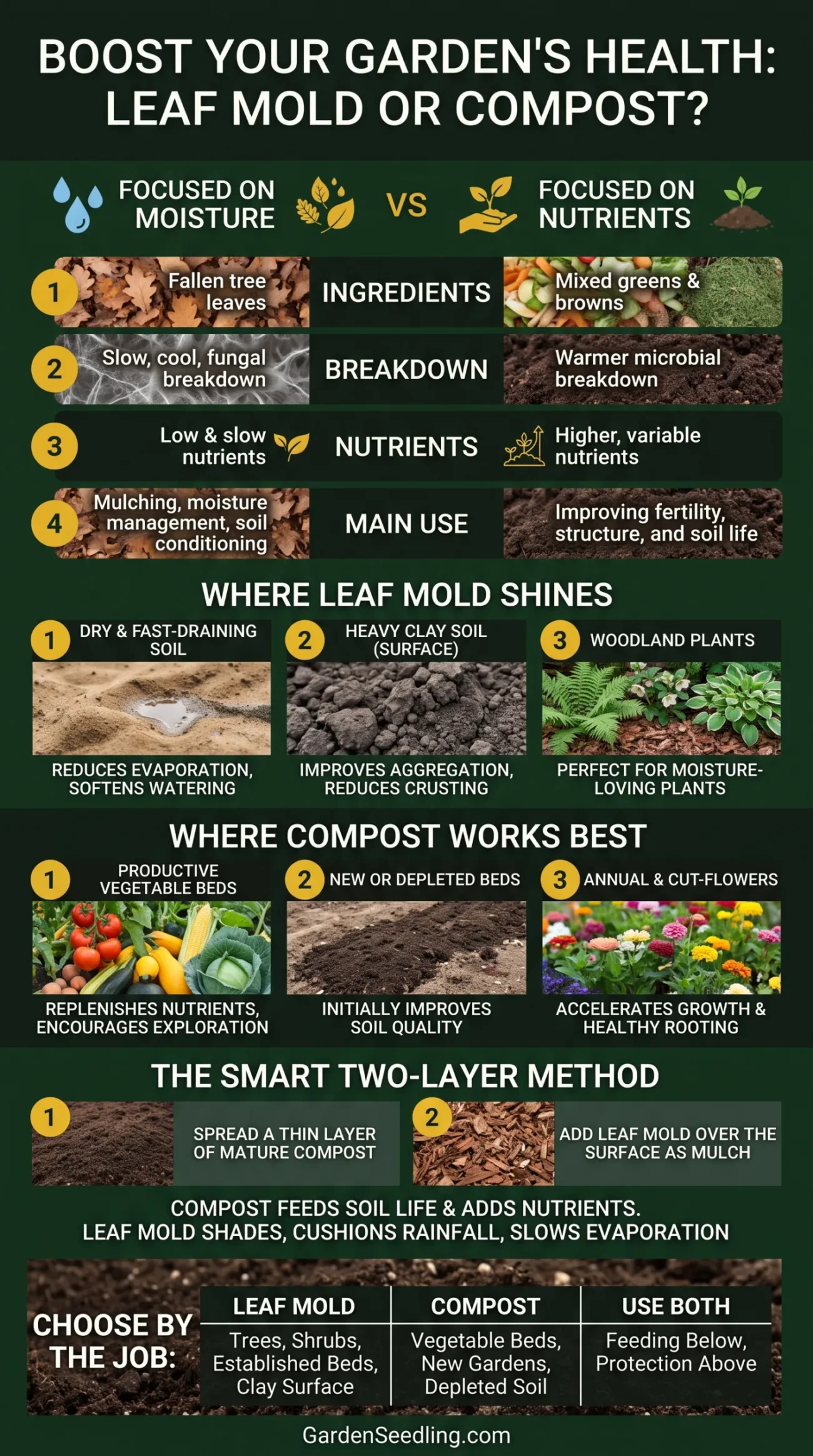
A pile of fallen leaves can become one of the gentlest soil conditioners in a garden, but it does not become the same material as finished compost. That difference matters. In a leaf mold vs compost comparison, compost usually does more for soil fertility, while leaf mold shines as a moisture-holding conditioner and surface mulch.

- What Separates Leaf Mold From Compost?
- Where Leaf Mold Works Best
- Dry Or Fast-Draining Beds
- Heavy Clay Soil
- Woodland Plants, Trees, And Shrubs
- Beds That Already Have Enough Nutrients
- Where Compost Works Best
- Vegetable Beds After Heavy Crops
- New Or Depleted Garden Beds
- Annual Flowers And Cut-Flower Beds
- Leaf Mold Vs Compost By Garden Use
- Choose For The Soil Problem, Not Just The Soil Type
- For Sandy Soil
- For Clay Soil
- For Soil With High Phosphorus
- Can You Use Leaf Mold And Compost Together?
- The Two-Layer Method
- How Much Should You Apply?
- Compost As A Topdressing
- Leaf Mold As Mulch
- Estimating The Volume
- Check Maturity Before Use
- Leaf Mold Readiness
- Compost Readiness
- When More Compost Causes Problems
- Common Leaf Mold And Compost Mistakes
- Expecting Leaf Mold To Feed Heavy Crops
- Filling A Raised Bed With Leaf Mold
- Using Garden Compost As Potting Mix
- Making Mulch Volcanoes
- Assuming All Leaves Make Identical Leaf Mold
- Choose By The Job
- Frequently Asked Questions
- Is Leaf Mold Better Than Compost For Clay Soil?
- Can Leaf Mold Replace Compost In A Vegetable Garden?
- Can Fresh Leaves Be Used Instead Of Leaf Mold?
- Is Leaf Mold Acidic?
- Can Leaf Mold And Compost Be Applied At The Same Time?
- Which One Is Better For Seed Starting?
Does your soil need food, water-holding help, or both? That is the useful question. Vegetable beds that carry heavy crops often benefit from mature compost. Dry borders, woodland plantings, and established trees may get more value from leaf mold. Many gardens need both—just not always in the same place or at the same rate.
Choose compost when you want to add a wider range of plant nutrients and improve biological activity. Choose leaf mold when the main job is holding moisture, covering bare soil, or improving texture without adding much fertility. For productive beds that dry quickly, place mature compost on the soil and leaf mold over it as mulch.
What Separates Leaf Mold From Compost?
Leaf mold comes from leaves that break down slowly in a moist pile, cage, or bag. Fungi do much of the work, especially during the cooler stages. The finished material smells like damp woodland soil and may range from flaky pieces to a fine, dark texture.
Compost starts with a mixed set of materials. Dry leaves, shredded stems, grass clippings, vegetable scraps, and other garden residues supply different amounts of carbon and nitrogen. When the pile has enough air and moisture, microbes break the ingredients down into a crumbly amendment.
The raw materials shape the result. Leaf mold contains mostly leaf-derived carbon and relatively small amounts of readily available nutrients. Compost can contain more nitrogen, phosphorus, potassium, and trace nutrients, though the amount varies widely. Yard-waste compost, food-scrap compost, and manure-based compost are not interchangeable products.
| Feature | Leaf Mold | Compost |
|---|---|---|
| Main ingredients | Fallen tree leaves | Mixed green and brown organic materials |
| Breakdown pattern | Slow, cool, and largely fungal | Microbial and often warmer when managed |
| Typical time | About one year for rough mulch; often two years for a fine conditioner | Several months to a year, depending on ingredients and management |
| Nutrient contribution | Low and slow | Higher, but highly variable |
| Best-known use | Mulching, moisture management, and soil conditioning | Improving fertility, structure, and soil life |
| Main misuse risk | Expecting it to feed demanding crops | Applying too much nutrient-rich or salty material |
One naming detail causes needless confusion. Leaf mold here means decomposed leaves, not a fungal disease growing on a plant. Also, compost used as a soil amendment is different from commercial potting mix. A bag labeled for containers may include peat, bark, coir, perlite, fertilizer, or wetting agents rather than finished garden compost.
Where Leaf Mold Works Best
Leaf mold is useful when you want organic matter with a soft touch. It improves the way soil handles water, shields the surface from sun and pounding rain, and slowly blends into the upper layer. Not flashy. Very useful, though.
Dry Or Fast-Draining Beds
Sandy soil loses water quickly because it has large pore spaces and little capacity to hold moisture near roots. A layer of leaf mold reduces direct evaporation and softens the swing between freshly watered and bone-dry soil. As it breaks down, it also adds organic material that helps the soil retain more water.
Apply leaf mold after watering or rain, while the ground is already moist. Mulching dusty, dry soil can trap dryness underneath—a small detail, but one that changes the result.
Heavy Clay Soil
Fine, mature leaf mold can make the surface of clay soil easier to work over time. It will not change clay into loam overnight, nor should it. What it can do is support aggregation, reduce surface crusting, and give worms and other soil organisms a steady supply of decaying material.
Keep coarse, half-rotted leaves near the surface. Digging a thick mass of unfinished leaves into the root zone may create uneven pockets, slow planting, and temporarily tie up some available nitrogen while decomposition continues.
Woodland Plants, Trees, And Shrubs
Under deciduous trees, leaf litter already forms a natural recycling layer. Leaf mold fits that setting well around hostas, ferns, hellebores, shrubs, and other plants that prefer cool root zones. It also works around newly planted trees, provided the mulch stays several inches away from the trunk.
- Spread it wide: Cover part of the root zone instead of making a narrow ring.
- Keep trunks clear: Do not build a damp mound against bark.
- Check the soil first: Water before mulching if the ground is dry.
- Top up when needed: Leaf mold settles as organisms pull it into the soil.
Beds That Already Have Enough Nutrients
Established flower borders sometimes receive compost every spring whether they need it or not. If plants grow well and a soil test shows adequate fertility, another nutrient-rich layer may serve little purpose. Leaf mold can cover and condition the soil without adding the same nutrient load.
Where Compost Works Best
Finished compost improves the physical, chemical, and biological sides of soil at the same time. It adds organic matter, supports soil organisms, and supplies nutrients in forms that usually release more slowly than soluble fertilizer. Still, compost is not a measured fertilizer unless you know its analysis.
Vegetable Beds After Heavy Crops
Tomatoes, squash, corn, cabbage, and other productive crops remove nutrients as they grow and leave the garden at harvest. Mature compost helps return organic matter and some nutrients to the bed. It also improves water infiltration and creates pore space that roots can explore.
For an established vegetable bed, a thin topdressing is often enough. Repeatedly burying several inches of compost each year can push phosphorus, potassium, and soluble salts beyond what plants need, especially when the product contains manure.
New Or Depleted Garden Beds
Low-organic-matter soil may benefit from a larger first application than an established bed. Work mature compost into the upper soil layer before planting, then switch to lighter surface additions in later years. The exact amount depends on soil texture, compost source, and test results—not on a fixed annual habit.
New raised beds also need mineral soil, not just fluffy organic material. A blend dominated by loam or quality topsoil, with mature compost added in a measured amount, settles less and provides a steadier root environment. Leaf mold can join the mix in a modest share or sit on top as mulch, but it should not fill the entire bed.
Annual Flowers And Cut-Flower Beds
Fast-growing annuals often respond well to compost where the native soil is poor. The benefit comes from improved rooting conditions as much as from nutrients. A bed that drains better, holds moisture evenly, and stays biologically active gives young plants a smoother start.
Leaf Mold Vs Compost By Garden Use
| Garden Situation | Better Starting Choice | Why |
|---|---|---|
| Nutrient-poor vegetable bed | Compost | Adds organic matter plus a wider nutrient range |
| Dry sandy border | Both | Compost supports fertility; leaf mold slows surface water loss |
| Heavy clay surface | Mature leaf mold or compost | Either can add organic matter and improve aggregation |
| Tree and shrub border | Leaf mold | Provides a gentle, moisture-conserving surface layer |
| New raised bed | Compost in a soil-based mix | Supports fertility without relying on unstable organic volume alone |
| Established perennial bed with rich soil | Leaf mold | Conditions and covers soil with less added fertility |
| Seed-starting mix | Neither by itself | Seeds need a fine, clean, well-aerated medium with predictable drainage |
| Container garden | Potting mix | Garden amendments alone may compact or drain poorly in pots |
Choose For The Soil Problem, Not Just The Soil Type
Sandy soil does not always need the same treatment. A sandy vegetable bed with pale growth may need compost for nutrients, while a sandy native-plant border may mainly need mulch and steadier moisture. Clay brings the same sort of choice: poor structure points toward organic matter, but lush growth and high soil phosphorus argue against another heavy compost application.
For Sandy Soil
- Use compost when crops need fertility and better nutrient retention.
- Use leaf mold as a surface mulch when irrigation disappears too quickly.
- Use both when a productive bed is low in organic matter and dries fast.
For Clay Soil
- Apply mature material: Fine compost or well-rotted leaf mold blends more evenly with the surface.
- Avoid working wet clay: Foot traffic and digging can smear and compact it.
- Favor topdressing: Worms, roots, frost, and wet-dry cycles can move organic matter downward gradually.
For Soil With High Phosphorus
Leaf mold often makes more sense when the soil needs cover and organic material but not another dose of nutrient-rich compost. Check the compost source, too. Manure-based products commonly carry more phosphorus and salts than compost made mostly from leaves and yard trimmings.
Can You Use Leaf Mold And Compost Together?
Yes, and layering them is often more useful than mixing equal amounts. The two materials can handle different jobs in the same bed.
The Two-Layer Method
- Pull established weeds and water dry soil.
- Spread a thin layer of mature compost where fertility needs attention.
- Keep compost away from crowns and woody stems.
- Add leaf mold over the surface as mulch.
- Leave a small open ring around stems and trunks.
Below, compost feeds soil life and adds nutrients. Above, leaf mold shades the surface, cushions rainfall, and slows evaporation. This setup works well in vegetable beds, berry rows, mixed borders, and newly planted shrub areas.
Do not bury unfinished leaf mold under seedlings. Rough material is better used on top, where it can keep decomposing without crowding young roots or creating uneven pockets in the planting zone.
How Much Should You Apply?
Application depth should match the job. A feeding layer and a mulch layer are not the same thing.
Compost As A Topdressing
For many established vegetable and flower beds, about 1/2 to 1 inch of mature compost is a practical starting range. Use less when the bed receives compost every year, the material contains manure, or soil tests already show high phosphorus or potassium.
A new bed with very low organic matter may take a deeper one-time application, often around 1 to 3 inches, mixed into the upper soil. Do not treat that as an automatic yearly dose. After the soil improves, lighter additions usually make more sense.
Leaf Mold As Mulch
A layer around 2 inches deep works for many beds. Coarse leaf mold may settle quickly and need a little more; fine material can form a denser layer, so avoid piling it too thickly. Keep it off plant crowns, vegetable stems, and tree bark.
Estimating The Volume
Cubic feet needed = bed area in square feet × layer depth in inches ÷ 12
Example: A 4-by-8-foot bed has 32 square feet. A 1-inch layer needs about 2.7 cubic feet. A 2-inch mulch layer needs about 5.3 cubic feet.
This calculation estimates volume, not nutrient need. One compost may be mild yard-waste material; another may carry enough manure-derived nutrients that a smaller amount is safer.
Check Maturity Before Use
The label matters less than the state of the material. Half-finished compost and one-year leaf mold behave differently from fully matured products.
Leaf Mold Readiness
- Young leaf mold: Leaves remain visible and the texture feels flaky. Use it as mulch.
- Older leaf mold: The material looks darker, finer, and more soil-like. Use it as a conditioner or as a small part of a homemade growing mix.
- Too dry: Leaves stay crisp and show little breakdown. Moisten the pile.
- Waterlogged: The mass turns slimy and sour-smelling. Open it, drain excess water, and add air.
Compost Readiness
- Smell: Finished compost should smell earthy, not sour or strongly of ammonia.
- Temperature: It should no longer heat sharply after turning.
- Texture: Most original ingredients should be hard to identify.
- Seedling safety: Avoid using questionable or salty compost around seeds and young transplants.
A dark color alone proves very little. Wet shredded leaves can look finished before their structure has broken down, and poorly cured compost can look crumbly while still carrying high salts.
When More Compost Causes Problems
Compost is organic, but “organic” does not mean unlimited. Repeated heavy applications can build phosphorus and potassium beyond crop needs. Soluble salts may also rise, especially with manure-based compost, mushroom compost, or products made from salty feedstocks.
Seeds and young roots notice first. Germination may slow, leaf edges may burn, or plants may struggle even though the bed looks dark and rich. The fix is not another amendment piled on top.
- Test the soil if compost has been added heavily for several years.
- Read product analysis when buying bulk or bagged compost.
- Reduce or pause applications when phosphorus and potassium are already high.
- Use leaf mold or another low-nutrient mulch when the surface still needs protection.
- Avoid guessing with seedlings because salt injury can happen before symptoms become obvious.
Common Leaf Mold And Compost Mistakes
Expecting Leaf Mold To Feed Heavy Crops
Leaf mold adds organic matter and small amounts of nutrients as it decays, but it does not act like rich compost or a balanced fertilizer. Tomatoes growing in poor soil will not thrive simply because the surface has a deep leaf-mold layer.
Filling A Raised Bed With Leaf Mold
Leaf mold shrinks as it finishes decomposing. Used alone, it also lacks the mineral fraction and stable structure that a long-term raised bed needs. Add it modestly to a soil-based blend or use it on top.
Using Garden Compost As Potting Mix
Containers need a medium that drains while holding enough air after repeated watering. Straight compost can stay too dense, vary in salts, or collapse as it breaks down. Blend only mature, screened compost into a tested potting recipe—or buy a mix made for containers.
Making Mulch Volcanoes
Leaf mold and compost should not touch tree trunks. Constant moisture against bark can encourage decay and hide rodent damage. Shape the mulch like a wide, shallow ring, not a cone.
Assuming All Leaves Make Identical Leaf Mold
Thin deciduous leaves usually break down faster than thick, waxy ones. Shredding oak, sycamore, magnolia, or similarly tough leaves speeds the process and prevents broad leaves from matting together. Pine needles can be collected separately because they decompose slowly and create a different-textured material.
Choose By The Job
Use compost for a depleted vegetable bed, a new annual-flower area, or soil that needs more fertility along with organic matter.
Use leaf mold around trees, shrubs, woodland plants, and beds where moisture control matters more than extra nutrients.
Use both when the soil needs feeding below and protection above. Compost first, leaf mold second. Simple, and usually more sensible than asking one material to do every job.
Frequently Asked Questions
Is Leaf Mold Better Than Compost For Clay Soil?
Either can help clay soil by adding organic matter. Choose compost if fertility is low. Choose mature leaf mold when you mainly want better surface structure, moisture balance, and a low-nutrient mulch.
Can Leaf Mold Replace Compost In A Vegetable Garden?
Usually not completely. Leaf mold helps moisture and soil texture, but demanding vegetables may still need compost or another measured nutrient source.
Can Fresh Leaves Be Used Instead Of Leaf Mold?
Shredded fresh leaves can work as surface mulch in a thin layer. They do not have the fine texture or stability of finished leaf mold, so avoid digging thick amounts into planting soil.
Is Leaf Mold Acidic?
Finished leaf mold from mixed deciduous leaves is not a dependable way to lower soil pH. Its acidity changes during decomposition, and most garden soils resist large pH shifts from a surface application.
Can Leaf Mold And Compost Be Applied At The Same Time?
Yes. Spread mature compost in a thin layer where nutrients are needed, then cover it with leaf mold to reduce evaporation and protect the soil surface.
Which One Is Better For Seed Starting?
Neither should be used alone. Seedlings need a fine, clean, airy medium with predictable drainage. Only fully mature, screened material belongs in a seed-starting blend, and then only in a tested proportion.